Why Specialty-Aware AI Medical Scribes Are the Future of Clinical Documentation
Discover why specialty-aware AI medical scribes are transforming clinical documentation with more accurate, specialty-specific SOAP notes.
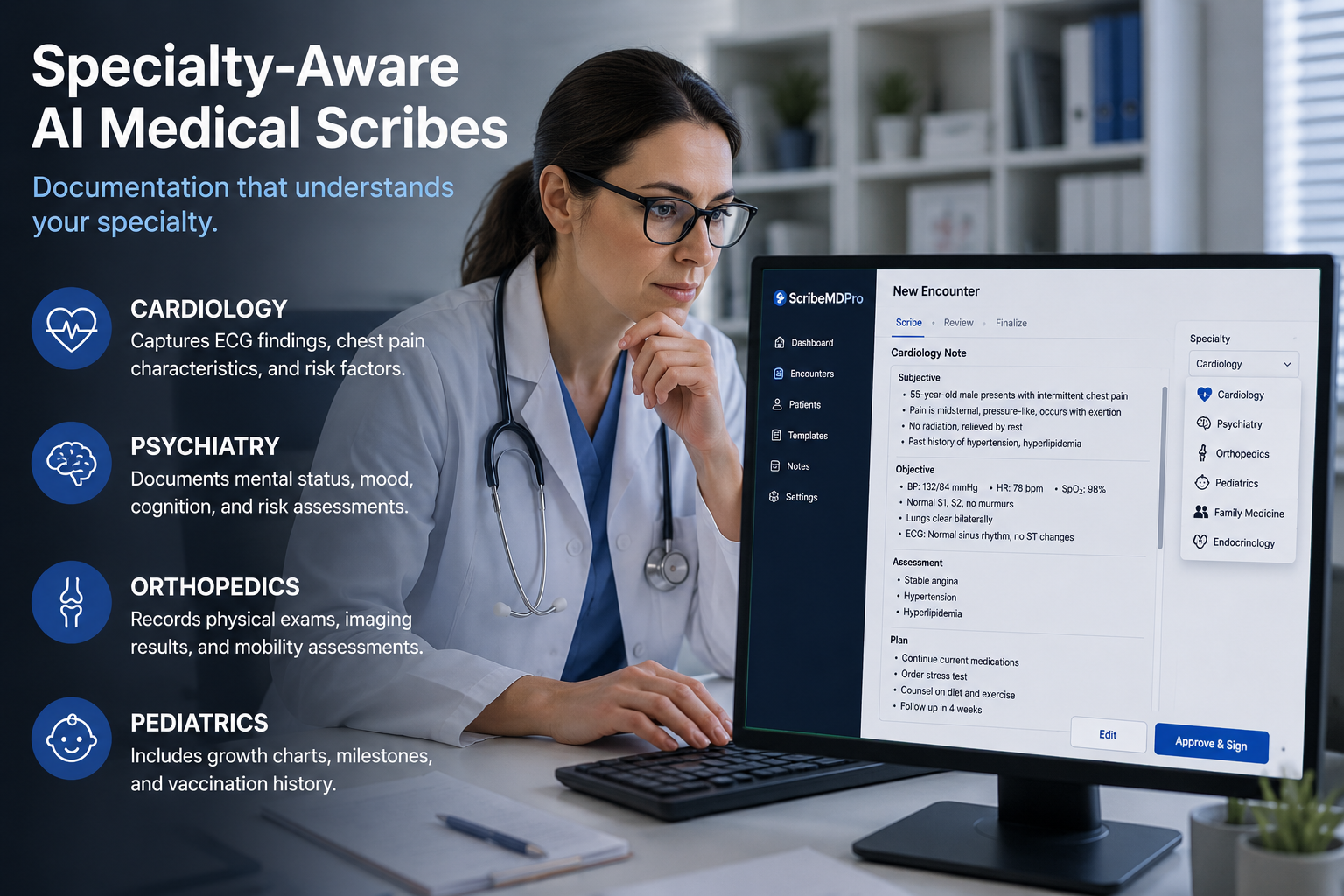
Why Specialty-Aware AI Medical Scribes Are the Future of Clinical Documentation
Artificial intelligence is rapidly transforming healthcare documentation. However, one limitation of many AI medical scribes is that they generate generic clinical notes regardless of medical specialty.
A cardiologist documents patient encounters differently than a psychiatrist. An orthopedic surgeon focuses on different clinical findings than a pediatrician. This is why the future of AI medical documentation lies in specialty-aware AI medical scribes.
What Is a Specialty-Aware AI Medical Scribe?
A specialty-aware AI medical scribe understands that different medical specialties require different documentation styles, clinical terminology, workflows, and note structures.
Rather than producing one generic SOAP note template, the AI adapts its documentation to the clinician's specialty.
Why Generic Documentation Isn't Always Enough
Healthcare is diverse.
Each specialty has unique requirements.
For example:
Family Medicine
Documentation often includes:
•Preventive care •Chronic disease management •Vaccination history •Lifestyle counseling
Cardiology
Notes frequently emphasize:
•Chest pain characteristics •ECG interpretation •Cardiovascular risk factors •Blood pressure trends
Psychiatry
Documentation focuses on:
•Mental status examination •Mood and effect •Cognitive assessment •Risk assessment •Behavioral observations
Pediatrics
Clinical notes commonly include:
•Growth charts •Developmental milestones •Vaccination status •Parent observations
Benefits of Specialty-Aware AI
Improved Documentation Accuracy
Specialty-specific terminology reduces ambiguity and improves note quality.
Better Clinical Workflow
Clinicians spend less time editing AI-generated documentation because the structure better matches their specialty.
Increased Trust
Healthcare professionals are more likely to adopt AI when documentation reflects how they actually practice medicine.
Reduced Administrative Burden
Less editing means more time available for patient care.
AI Should Support Clinical Judgment
A specialty-aware AI medical scribe does not replace clinical expertise.
Instead, it assists clinicians by organizing relevant information into structured documentation while allowing the clinician to review, edit, and approve every note.
Human oversight remains essential.
The Future of Clinical Documentation
Future AI documentation systems are expected to become:
•More specialty-specific •Better integrated with clinical workflows •More context-aware •Better at recognizing medical terminology •More adaptable to different
healthcare settings Healthcare AI will continue to evolve from simple transcription tools into intelligent clinical documentation assistants.
How ScribeMDPro Is Building Toward This Vision
At ScribeMDPro, we believe clinical documentation should reflect the realities of each medical specialty.
Our vision includes developing specialty-aware documentation that adapts note structure, terminology, and workflows to support clinicians across multiple fields of medicine while maintaining clinician oversight.
By focusing on specialty-aware AI, we aim to help healthcare professionals reduce documentation time without compromising quality or clinical accuracy.
Conclusion
The future of AI medical documentation is not simply faster note generation—it is smarter, specialty-aware documentation that aligns with how clinicians actually practice medicine.
As healthcare continues to embrace AI, specialty-aware medical scribes will play an increasingly important role in improving efficiency while preserving high standards of patient care.