Why Healthcare AI Needs Trust Before Intelligence
Healthcare AI is only as valuable as the trust clinicians place in it. Explore the principles that make AI medical documentation reliable, secure, and clinically useful.
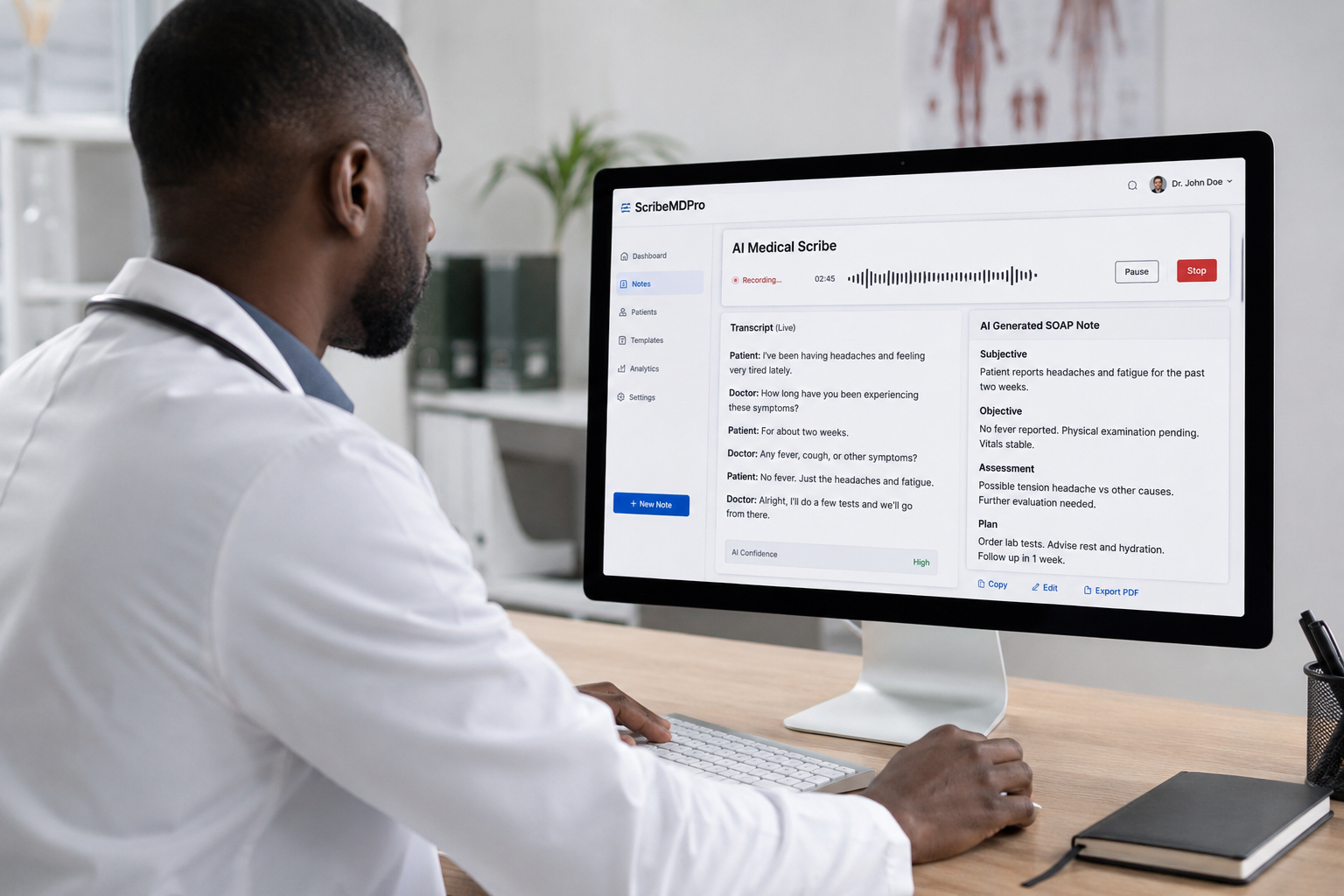
Why Healthcare AI Needs Trust Before Intelligence
Introduction
Artificial intelligence is rapidly transforming healthcare. From clinical decision support to automated documentation, AI promises to reduce administrative burden and improve efficiency. However, one principle remains clear: an AI system is only valuable if healthcare professionals can trust it.
For clinicians, trust is not built through marketing claims or impressive demonstrations. It is earned through reliability, transparency, security, and consistent performance during real patient encounters.
This is why modern healthcare AI platforms must prioritize trust before intelligence.
The Challenge of Clinical Documentation
Physicians spend a significant portion of their working day documenting patient encounters. Clinical documentation is essential for:
•Patient safety •Continuity of care •Billing and reimbursement •Regulatory compliance •Medical-legal protection
Yet documentation often contributes to physician burnout by reducing the time available for direct patient interaction.
AI medical scribes aim to solve this challenge—but only if clinicians trust the technology.
What Builds Trust in Healthcare AI?
Healthcare organizations evaluate AI solutions using several critical factors.
- Documentation Accuracy Clinical notes must accurately reflect patient conversations without inventing facts or omitting clinically relevant information.
Healthcare providers expect documentation that supports safe clinical decision-making.
- Data Security
Medical documentation contains sensitive health information.
Healthcare AI platforms should demonstrate strong security practices, including:
•Encryption •Secure authentication •Controlled access •Privacy-focused system design
Trust begins with protecting patient information.
- Clinical Transparency
Clinicians should understand:
•How notes are generated. •When AI confidence is low. •Which sections require review.
AI should support clinicians—not replace their professional judgement.
- Reliability
Healthcare professionals need systems that perform consistently.
Reliable AI means:
•Stable transcription •Fast response times •Minimal downtime •Consistent formatting •Predictable workflows
Dependability often matters more than adding another feature.
Human Oversight Remains Essential
AI can accelerate documentation, but clinicians remain responsible for reviewing and approving medical records.
Human oversight ensures:
•Clinical accuracy •Appropriate medical terminology •Contextual interpretation •Patient safety
The future of healthcare documentation is collaborative, combining clinician expertise with AI efficiency.
How ScribeMDPro Approaches Trust
At ScribeMDPro, our goal is not simply to generate clinical notes.
We are building a platform that emphasizes:
•Secure AI-assisted documentation •Structured clinical workflows •Professional documentation standards •Reliable performance •Continuous improvement based on user feedback
Every new feature is evaluated not only for innovation but also for its ability to improve clinician confidence.
The Future of Healthcare AI
Healthcare AI will continue to evolve rapidly.
The platforms that succeed will not necessarily be those with the largest number of features, but those that consistently earn the confidence of clinicians through quality, transparency, and reliability.
Trust will remain the foundation upon which intelligent healthcare systems are built.
Conclusion
Artificial intelligence has enormous potential to improve healthcare documentation.
However, technology alone is not enough.
When clinicians trust AI, documentation becomes faster, more consistent, and less burdensome—allowing healthcare professionals to spend more time where it matters most: with their patients.