What Is Ambient Clinical Intelligence? The Future of AI in Healthcare
Discover how Ambient Clinical Intelligence is transforming healthcare by reducing documentation burden and helping clinicians focus on patient care.
What Is Ambient Clinical Intelligence? The Future of AI in Healthcare
Healthcare is undergoing a digital transformation, and one of the most exciting innovations is Ambient Clinical Intelligence (ACI). By combining artificial intelligence, speech recognition, and natural language processing, Ambient Clinical Intelligence is helping clinicians reduce administrative workload while improving the patient experience.
But what exactly is Ambient Clinical Intelligence, and why is it becoming an essential technology in modern healthcare?
What Is Ambient Clinical Intelligence?
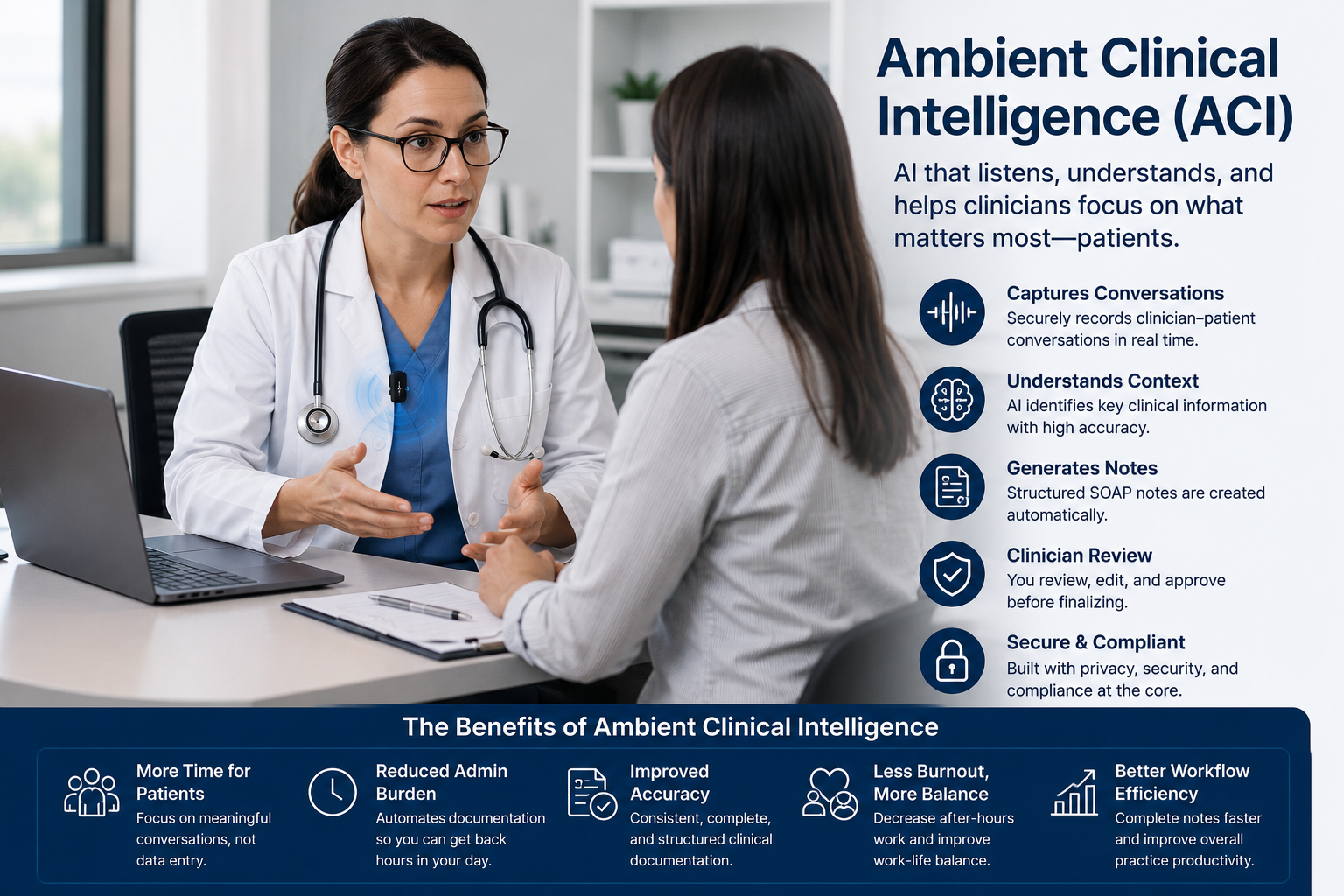
Ambient Clinical Intelligence (ACI) refers to AI systems that automatically capture and process conversations between clinicians and patients during consultations.
Rather than requiring clinicians to type notes during an appointment, ACI listens in real time, extracts clinically relevant information, and generates structured documentation for review.
The clinician remains in control, reviewing and approving the documentation before it becomes part of the patient's medical record.
How Does Ambient Clinical Intelligence Work?
A typical workflow includes:
1.Securely capturing the clinician–patient conversation. 2.Converting speech into text using speech recognition. 3.Identifying clinically relevant information. 4.Organizing information into structured SOAP notes. 5.Allowing clinicians to review, edit, and approve the final documentation.
This process reduces administrative burden without replacing clinical decision-making.
Benefits of Ambient Clinical Intelligence
- More Time for Patients
Clinicians can focus on listening and communicating rather than typing throughout the consultation.
- Reduced Administrative Burden
Documentation can consume hours of a clinician's day. ACI automates much of this process, allowing more time for direct patient care.
- Improved Documentation Consistency
AI can help produce structured, standardized notes that are easier to review and maintain.
- Reduced Physician Burnout
By decreasing after-hours documentation, Ambient Clinical Intelligence helps improve work-life balance and reduce burnout.
- Better Clinical Workflow
Notes are generated shortly after the consultation, enabling clinicians to complete documentation more efficiently.
Is Ambient Clinical Intelligence Safe?
Healthcare organizations implementing ACI should ensure:
•Secure handling of patient information •Compliance with applicable privacy regulations •Encryption of data during storage and transmission •Clinician review before finalizing documentation
Responsible implementation is essential for maintaining trust and protecting patient confidentiality.
Common Misconceptions
Myth: AI replaces physicians.
Reality: AI assists with documentation, but clinicians remain responsible for diagnosis, treatment, and final documentation.
Myth: AI documentation requires no review.
Reality: Every AI-generated note should be reviewed and approved by the clinician.
Myth: Ambient AI records everything permanently.
Reality: Implementation varies by system, and healthcare organizations should establish clear policies regarding recording, retention, and privacy.
The Future of Ambient Clinical Intelligence
As AI continues to evolve, Ambient Clinical Intelligence is expected to become:
•More specialty-aware •Better integrated with electronic health record systems •More accurate in understanding clinical terminology •More adaptable to different
healthcare settings The goal is not to replace clinicians but to support them with efficient, reliable documentation tools.
How ScribeMDPro Fits Into This Future
ScribeMDPro is designed around the principles of Ambient Clinical Intelligence.
It securely captures clinical conversations and assists healthcare professionals by generating structured, specialty-aware SOAP notes that clinicians review before finalization.
Our mission is to reduce documentation burden while allowing clinicians to focus on delivering exceptional patient care.
Conclusion
Ambient Clinical Intelligence represents an important step toward more efficient, clinician-centered healthcare.
When implemented responsibly, it enables healthcare professionals to spend less time documenting and more time doing what matters most—caring for patients.