The Ultimate Guide to AI Medical Scribes: Everything Healthcare Professionals Need to Know (2026)
A comprehensive guide explaining AI medical scribes, how they work, their benefits, limitations, and why specialty-aware AI is shaping the future of clinical documentation.
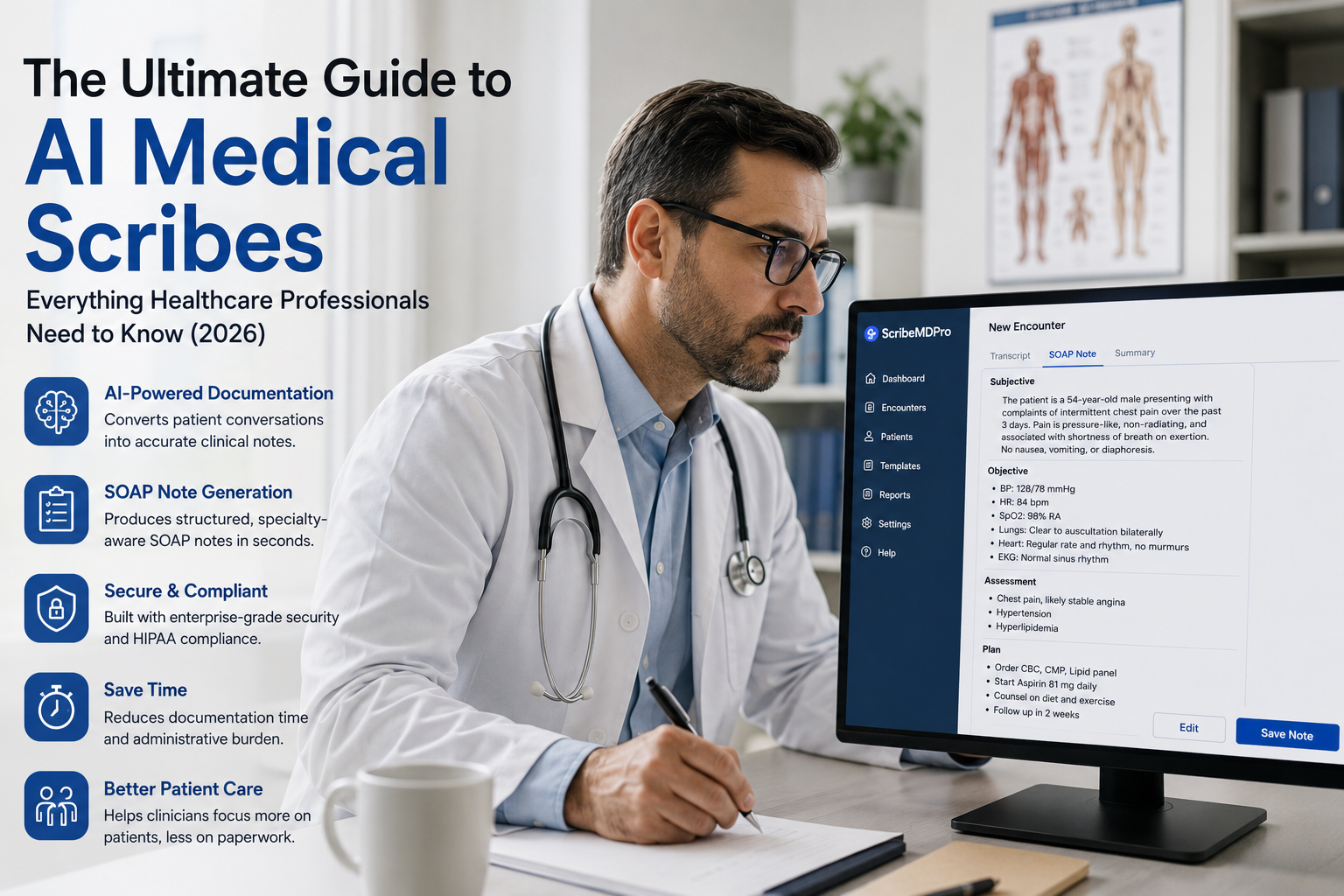
The Ultimate Guide to AI Medical Scribes: Everything Healthcare Professionals Need to Know (2026)
Introduction
Healthcare professionals around the world are facing an unprecedented documentation burden. Physicians, nurse practitioners, physician assistants, and other clinicians often spend hours documenting patient encounters, updating electronic health records (EHRs), and completing administrative tasks.
Artificial Intelligence (AI) is transforming this landscape through AI medical scribes—software designed to assist clinicians by converting patient conversations into structured clinical documentation.
This guide explains what AI medical scribes are, how they work, their benefits, limitations, and what healthcare professionals should consider when choosing one.
Table of Contents
1.What Is an AI Medical Scribe? 2.Why Clinical Documentation Is Challenging 3.How AI Medical Scribes Work 4.Ambient Clinical Intelligence Explained 5.AI Medical Scribes vs Human Medical Scribes 6.Benefits of AI Medical Scribes 7.Limitations and Challenges 8.Data Privacy and Security 9.Specialty-Aware Documentation 10.The Future of AI Medical Scribes 11.Choosing the Right AI Medical Scribe 12.Frequently Asked Questions 13.Final Thoughts
- What Is an AI Medical Scribe?
Define AI medical scribes, their purpose, and how they assist clinicians without replacing clinical judgment.
- Why Clinical Documentation Is Challenging
Discuss: •Administrative burden •Physician burnout •Documentation fatigue •Increasing patient volume •Regulatory requirements
- How AI Medical Scribes Work
Explain:
•Speech recognition •Natural language processing (NLP) •Medical language understanding •SOAP note generation •Clinician review and approval
- Ambient Clinical Intelligence (ACI)
Explain:
•Ambient listening •Context awareness •Workflow automation •Real-time documentation
- AI Medical Scribes vs Human Medical Scribes
Compare:
•Cost •Availability •Scalability •Accuracy •Workflow •Clinician oversight
- Benefits
Include:
•Reduced burnout •Faster documentation •Better patient engagement •More eye contact •Improved workflow •Standardized notes
- Challenges
Discuss:
•AI hallucinations •Audio quality •Specialty adaptation •EHR integration •Privacy concerns •Clinician trust
- Security
Cover:
•Encryption •Authentication •Secure cloud infrastructure •Responsible AI •Regulatory compliance •Clinician review
- Why Specialty-Aware AI Matters
This should become one of the strongest sections.
Explain why:
•Psychiatry notes differ from •Family Medicine. •Cardiology differs from Pediatrics.
Emergency Medicine differs from Dermatology. Then explain how specialty-aware AI can improve clinician confidence and reduce editing time.
- Future Trends
Discuss:
•Ambient AI •Large Language Models •Real-time documentation •Clinical decision support •Multilingual AI •Specialty-aware AI •Voice-first healthcare
- Choosing an AI Medical Scribe Create a checklist.
Questions buyers should ask:
•Is it specialty-aware? •Does it generate SOAP notes? •Does it support clinician review? •Is documentation structured? •Is patient information protected? •Can it integrate with existing workflows? •Is it easy to use?
- Frequently Asked Questions
Answer questions such as:
•What is an AI medical scribe? •Are AI medical scribes accurate? •Can AI replace medical scribes? •Is AI documentation safe? •Do AI scribes work with SOAP notes? •How much time do AI scribes save? •Are AI medical scribes suitable for small clinics? •Can AI medical scribes work in different specialties?
- Final Thoughts
Conclude by emphasizing that AI should augment—not replace—clinical expertise, and that responsible AI solutions can help clinicians spend more time with patients and less time on documentation.
Mention ScribeMDPro naturally as an example of an AI-powered, specialty-aware documentation assistant.