SOAP Notes Explained: The Foundation of Clinical Documentation
Learn what SOAP notes are, why clinicians use them, and how AI-powered documentation makes creating SOAP notes faster and more accurate.
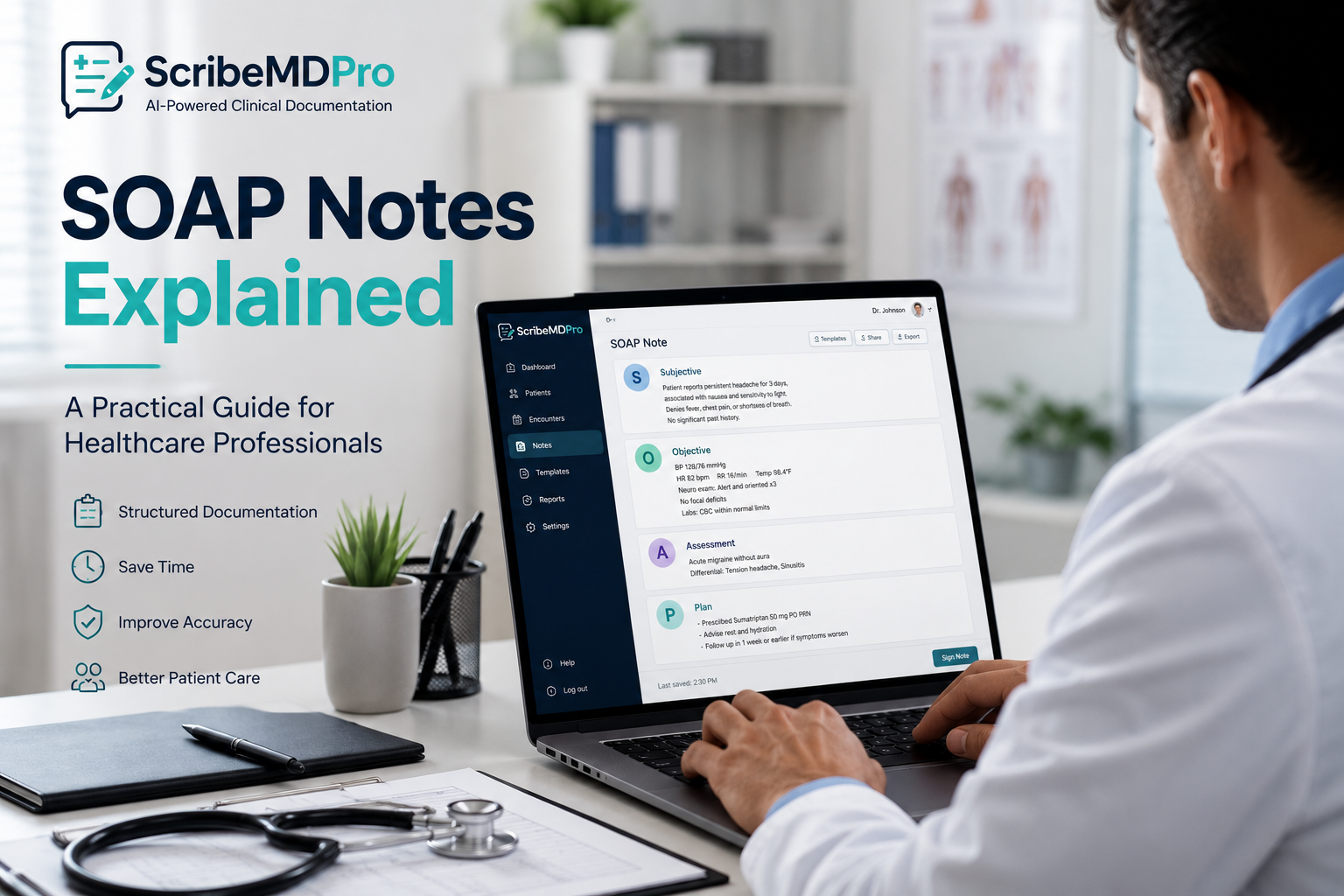
SOAP Notes Explained: The Foundation of Clinical Documentation
Every patient encounter tells a story. The challenge for clinicians is documenting that story accurately, efficiently, and consistently.
That is why SOAP notes have become the global standard for clinical documentation.
Whether you are a physician, nurse practitioner, physician assistant, or other healthcare professional, understanding SOAP documentation is essential for delivering high-quality patient care.
What Does SOAP Mean?
SOAP is an acronym for four sections of a clinical note:
Subjective (S) This section contains information reported directly by the patient. Examples include: •Chief complaint •History of present illness •Symptoms •Pain severity •Medical history •Family history •Social history
Because this information comes from the patient, it is considered subjective.
Objective (O)
This section records measurable clinical findings gathered by the clinician.
Examples include:
•Vital signs •Physical examination findings •Laboratory results •Imaging reports •Observable clinical signs
Objective findings provide evidence that supports clinical decision-making.
Assessment (A)
The assessment combines the subjective and objective information to determine the patient's condition.
Examples include:
•Clinical impression •Differential diagnoses •Confirmed diagnosis •Progress evaluation
This section reflects the clinician's professional judgment.
Plan (P)
The plan outlines the next steps in patient care.
Examples include:
•Medications •Laboratory tests •Imaging requests •Referrals •Patient education •Follow-up appointments
This section ensures continuity of care across healthcare providers.
Why SOAP Notes Matter
High-quality SOAP notes improve:
•Patient safety •Communication between healthcare providers •Legal documentation •Billing accuracy •Clinical continuity •Quality improvement
Poor documentation can lead to delays in care, coding errors, and increased administrative burden.
Common Challenges
Despite their importance, SOAP notes are often time-consuming.
Many clinicians spend hours after clinic completing documentation, contributing to administrative overload and burnout.
How AI Simplifies SOAP Documentation
Modern AI medical scribes can automatically:
•Capture clinician–patient conversations •Identify clinically relevant information •Organize findings into SOAP format •Reduce typing •Improve documentation consistency •Save valuable clinical time
Instead of spending evenings completing notes, clinicians can focus more on patient care.
The Future of Clinical Documentation
Artificial intelligence is transforming healthcare documentation by helping clinicians produce accurate, structured notes in less time.
When used responsibly, AI medical scribes support—not replace—clinical judgment.
The clinician always remains responsible for reviewing and approving the final documentation.
Final Thoughts
SOAP notes remain the cornerstone of modern clinical documentation. As healthcare evolves, AI-powered tools can reduce administrative burden while maintaining high standards of documentation quality.
The goal is simple: spend less time documenting and more time caring for patients.
Call to Action
Curious how AI can streamline your clinical documentation? Explore how ScribeMDPro helps clinicians convert conversations into structured SOAP notes quickly, securely, and efficiently.