How Much Time Can an AI Medical Scribe Save? A Realistic Look at Clinical Documentation
Discover how AI medical scribes help clinicians reduce documentation time, minimize after-hours charting, and improve workflow without replacing clinical judgment.
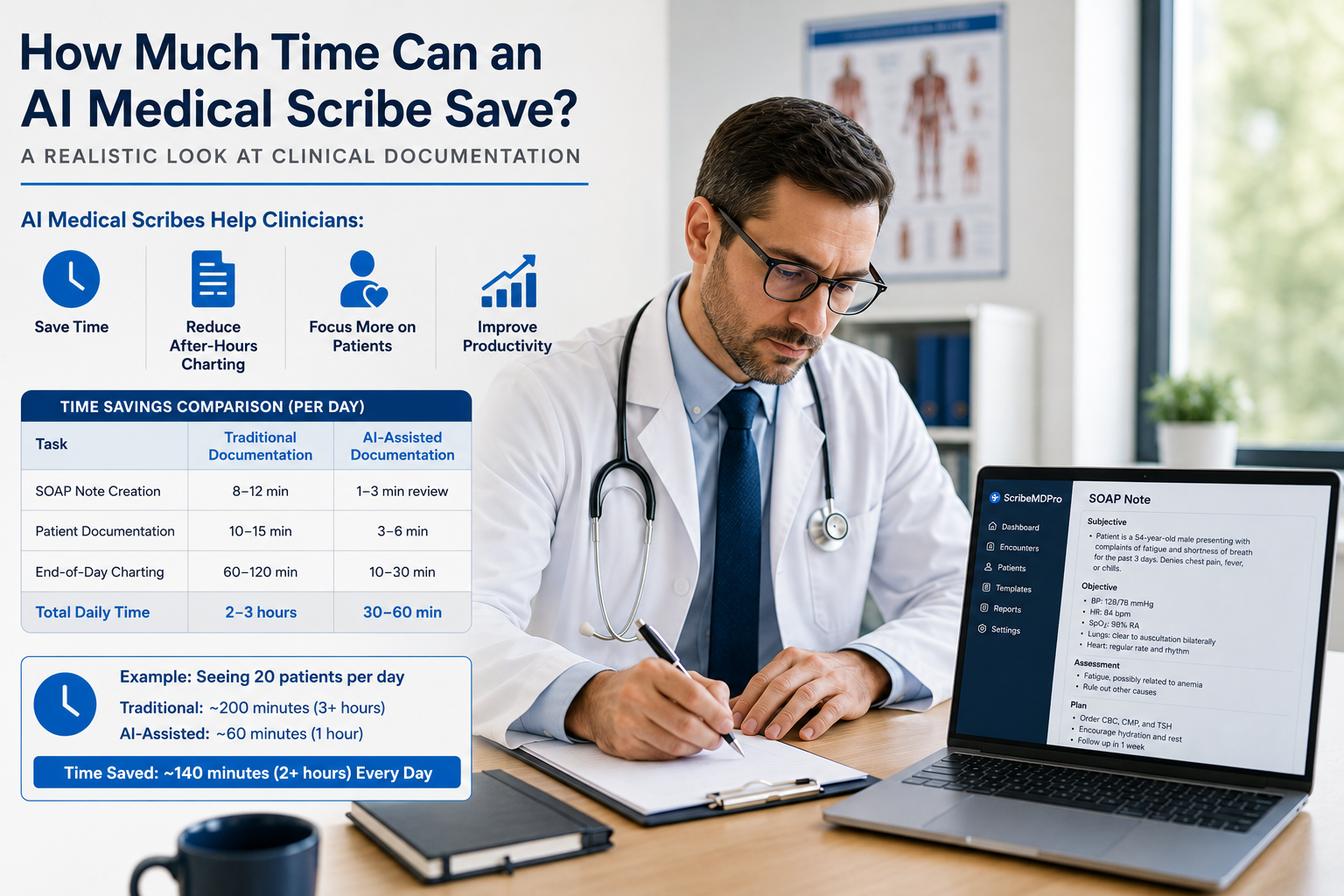
How Much Time Can an AI Medical Scribe Save? A Realistic Look at Clinical Documentation
Healthcare professionals dedicate years to mastering the art and science of medicine. Yet many clinicians find themselves spending a significant portion of their day documenting patient encounters rather than providing direct patient care.
Whether working in primary care, emergency medicine, cardiology, or another specialty, documentation is essential—but it is also one of the leading contributors to administrative burden and clinician burnout.
Artificial Intelligence (AI) medical scribes have emerged as a promising solution, offering to automate documentation while allowing clinicians to remain fully in control of their medical records.
But one question remains:
How much time can an AI medical scribe realistically save?
This article explores the answer using practical examples, realistic expectations, and current best practices in clinical documentation.
Why Clinical Documentation Takes So Much Time
Clinical documentation extends far beyond writing a few notes after each consultation.
Healthcare professionals routinely document:
•Patient history •Presenting complaints •Physical examination findings •Laboratory and imaging results •Clinical assessment •Treatment plans •Medication changes •Follow-up recommendations
Each patient encounter requires careful documentation to support continuity of care, communication among healthcare teams, and accurate medical records.
For many clinicians, documentation continues well after clinic hours—a phenomenon commonly referred to as "pajama time."
Where Clinicians Spend Documentation Time A typical patient encounter often includes documentation before, during, and after the consultation.
Common time-consuming activities include:
•Reviewing previous records •Recording patient history •Updating Electronic Health •Records (EHRs) •Writing SOAP notes •Ordering investigations •Completing referrals •Reviewing and signing documentation
Although each task may seem brief individually, together they can consume several hours every day.
How AI Medical Scribes Reduce Documentation Time
AI medical scribes streamline documentation by assisting with routine administrative tasks.
Instead of manually typing every detail, clinicians can focus on their patients while AI helps organize clinical information.
Modern AI medical scribes typically:
•Capture clinician-patient conversations •Convert speech into text •Identify clinically relevant information •Generate structured SOAP notes •Organize documentation into standardized formats •Present draft notes for clinician review
Importantly, clinicians remain responsible for reviewing, editing, and approving all documentation before it becomes part of the patient's medical record.
A Practical Example
Imagine a primary care physician seeing 20 patients each day.
If documentation takes approximately 10 minutes per patient, the clinician spends:
20 × 10 minutes = 200 minutes
That equals 3 hours and 20 minutes every day.
If an AI medical scribe reduces documentation review to 3 minutes per patient, the calculation becomes:
20 × 3 minutes = 60 minutes Daily documentation time
decreases from:
200 minutes → 60 minutes
This represents a potential savings of approximately:
140 minutes (2 hours and 20 minutes) every day.
Over a typical five-day workweek, that translates to nearly 12 hours saved, and over a year, hundreds of hours that can be redirected toward patient care, professional development, research, or personal well-being.
Why Review Time Still Matters
Despite impressive advances in artificial intelligence, AI-generated documentation should never replace clinical judgment.
Every note should be carefully reviewed to ensure:
•Clinical accuracy •Appropriate diagnoses •Correct medications •Complete treatment plans •Proper documentation of significant findings
AI should support clinicians—not replace their expertise.
Factors That Influence Time Savings
Not every healthcare setting experiences identical benefits.
Time savings depend on several factors, including:
Medical Specialty
Documentation requirements differ significantly between specialties.
For example:
•Psychiatry notes are typically narrative and detailed. •Emergency medicine prioritizes rapid documentation. •Cardiology often includes complex diagnostic findings. •Pediatrics incorporates developmental history and vaccination records.
Specialty-aware AI can reduce editing by adapting documentation to different clinical workflows.
Patient Complexity
Patients with multiple chronic conditions naturally require more detailed documentation than routine follow-up visits.
Audio Quality
High-quality recordings improve transcription accuracy and reduce editing time.
Electronic Health Record Integration
Efficient integration with existing clinical workflows minimizes unnecessary copying and pasting.
Clinician Familiarity
Healthcare professionals who regularly use AI documentation tools often become more efficient over time.
The Hidden Benefit: Reduced Cognitive Load
One of the most significant advantages of AI medical scribes is not simply saving minutes—it is reducing mental fatigue.
Clinicians no longer need to divide their attention between listening to patients and typing notes.
Instead, they can:
•Maintain eye contact •Build stronger patient relationships •Listen more attentively •Focus on clinical reasoning •Spend less mental energy on repetitive documentation
Reducing cognitive burden contributes to improved job satisfaction and may help decrease physician burnout.
Can AI Eliminate Documentation Completely?
No.
Clinical documentation remains an essential professional responsibility.
Healthcare professionals must continue to:
•Review every note •Verify medical accuracy •Exercise clinical judgment •Make diagnostic decisions •Approve final documentation
AI is designed to accelerate documentation—not eliminate clinician oversight.
How ScribeMDPro Helps Reduce Documentation Time
ScribeMDPro is designed to help healthcare professionals streamline clinical documentation through AI-assisted workflows.
Key capabilities include:
•Ambient clinical conversation capture •AI-powered transcription •Structured SOAP note generation •Specialty-aware documentation •Fast clinician review before final approval
Rather than replacing clinicians, ScribeMDPro supports healthcare professionals by reducing administrative burden while keeping them fully in control of every clinical note.
The Future of Documentation Efficiency
As artificial intelligence continues to evolve, documentation systems will become increasingly:
•Specialty-aware •Context-aware •Workflow-integrated •Multilingual •Accurate •Secure
Future AI medical scribes will not simply produce faster notes—they will create smarter documentation that reflects the unique requirements of different medical specialties.
Conclusion
AI medical scribes are transforming healthcare documentation by helping clinicians spend less time typing and more time caring for patients.
Although AI cannot replace clinical expertise, it can significantly reduce documentation workload, improve workflow efficiency, and decrease after-hours charting.
The greatest benefit is not merely saving time—it is giving clinicians more opportunities to focus on what matters most: delivering high-quality patient care.