How AI Medical Scribes Improve Patient Care Without Replacing Clinicians
Learn how AI medical scribes improve patient care by reducing documentation burden while keeping clinicians at the center of every medical decision.
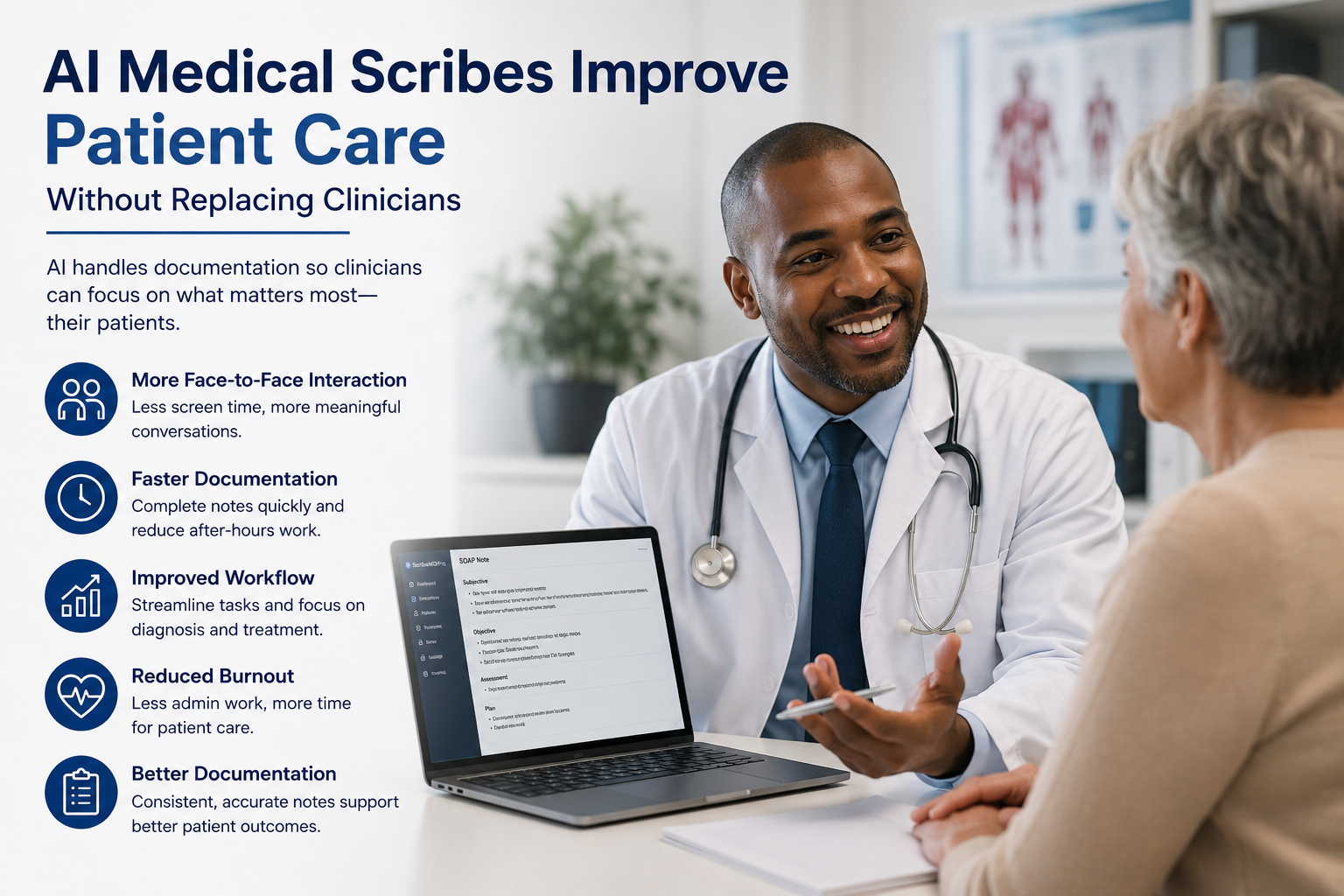
How AI Medical Scribes Improve Patient Care Without Replacing Clinicians
Artificial intelligence is becoming an integral part of modern healthcare, particularly in clinical documentation. While some worry that AI could replace healthcare professionals, the reality is quite different.
AI medical scribes are designed to support clinicians—not replace them. By reducing documentation time, they allow healthcare professionals to focus on what matters most: providing exceptional patient care.
The Documentation Challenge
Healthcare professionals often spend a significant portion of their day documenting patient encounters.
Administrative tasks can include:
•Writing SOAP notes •Updating electronic health records (EHRs) •Recording diagnoses •Documenting procedures •Completing follow-up documentation
These responsibilities are essential but time-consuming.
How AI Supports Clinicians
AI medical scribes assist clinicians by:
•Listening to clinical conversations •Converting speech into text •Organizing information into structured SOAP notes •Reducing repetitive typing •Helping complete documentation more efficiently
Importantly, the clinician remains responsible for reviewing and approving every note.
Five Ways AI Improves Patient Care
- More Face-to-Face Interaction
Instead of looking at a computer screen, clinicians can maintain better eye contact and communication with patients.
- Faster Documentation
Clinical notes can be completed shortly after the consultation, reducing after-hours paperwork.
- Improved Workflow
Efficient documentation allows clinicians to dedicate more time to diagnosis, treatment planning, and patient education.
- Reduced Burnout
By minimizing administrative workload, AI helps reduce one of the major contributors to physician burnout.
- Better Documentation Consistency
Structured documentation improves communication across healthcare teams and supports continuity of care.
What AI Cannot Do
AI is a tool—not a clinician.
It cannot:
•Diagnose diseases independently •Replace clinical judgment •Make treatment decisions •Interpret complex patient situations without clinician oversight
Healthcare professionals remain responsible for patient care and final documentation.
Responsible Use of AI in Healthcare
Successful AI implementation requires:
•Human review of generated notes •Secure handling of patient information •Compliance with healthcare privacy regulations •Ongoing monitoring of documentation quality
Trustworthy AI always keeps clinicians in control.
The Role of ScribeMDPro
ScribeMDPro was built to reduce documentation burden while preserving the clinician's authority.
The platform helps healthcare professionals generate structured, specialty-aware SOAP notes, allowing them to spend more time engaging with patients instead of typing.
Our goal is simple:
Help clinicians practice medicine—not paperwork.
Conclusion
AI medical scribes are transforming healthcare by improving efficiency without replacing the expertise, compassion, and clinical judgment of healthcare professionals.
The future of healthcare is one where AI and clinicians work together to deliver better patient outcomes.