How AI Medical Scribes Help Reduce Physician Burnout
Physician burnout remains one of healthcare's greatest challenges. Learn how AI medical scribes can reduce documentation burden and help clinicians reclaim valuable time.
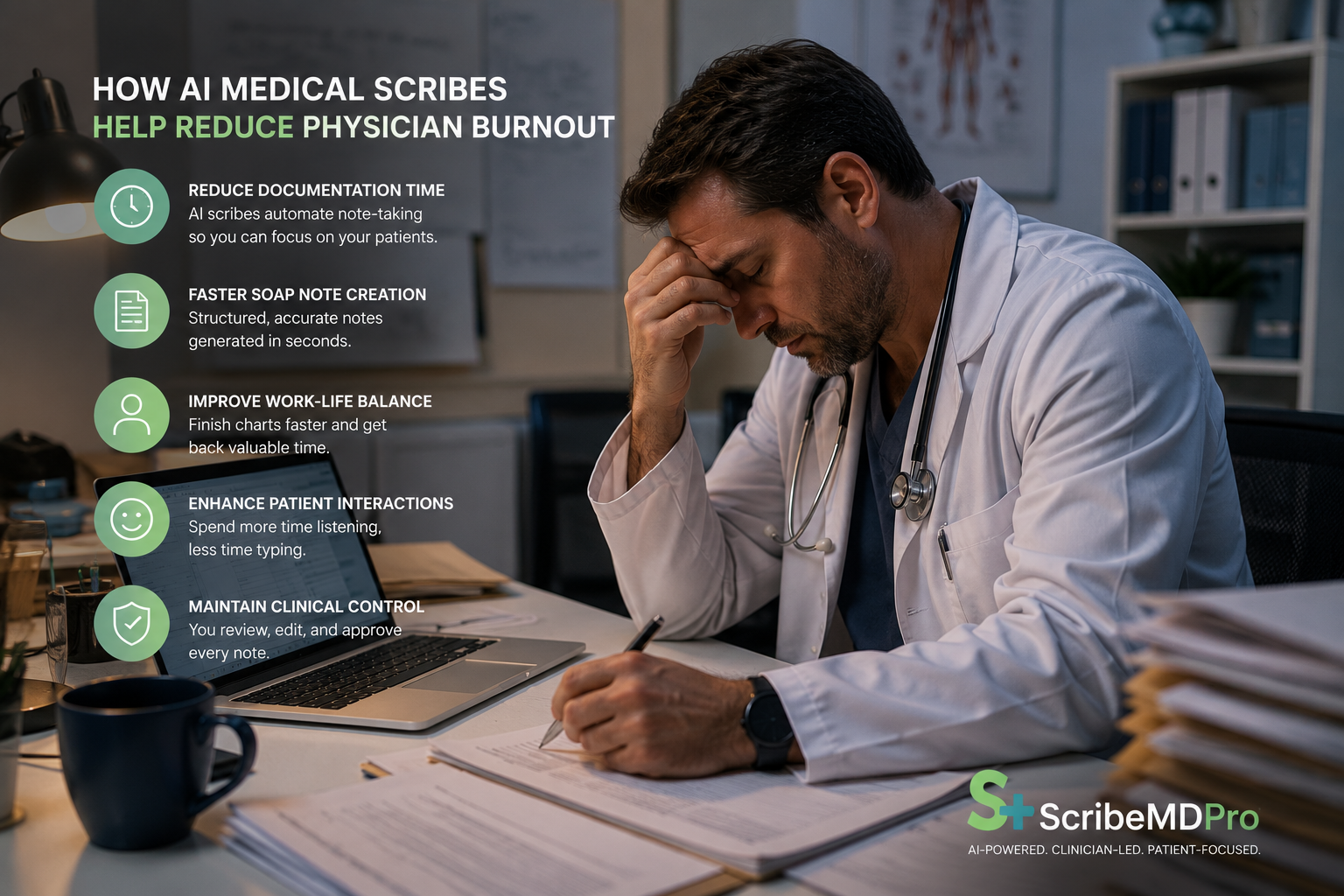
How AI Medical Scribes Help Reduce Physician Burnout
Introduction
Physician burnout has become a global healthcare concern. Long working hours, increasing patient volumes, administrative responsibilities, and extensive documentation requirements contribute to physical and emotional exhaustion.
While no technology can solve burnout entirely, AI medical scribes are emerging as valuable tools that reduce one of its most significant contributors—clinical documentation.
By assisting clinicians with accurate, structured documentation, AI allows healthcare professionals to spend more time with patients and less time completing notes.
Understanding Physician Burnout
Burnout is characterized by:
•Emotional exhaustion •Depersonalization •Reduced professional satisfaction •Mental fatigue •Increased administrative stress
Healthcare organizations increasingly recognize burnout as a threat to clinician well-being, workforce retention, and patient care quality.
Documentation Is a Major Contributor
Modern healthcare requires detailed clinical documentation for communication, continuity of care, quality improvement, reimbursement, and legal purposes.
However, clinicians frequently spend several hours each day documenting patient encounters. Many continue charting after clinic hours—a phenomenon commonly referred to as "pajama time."
This reduces work-life balance and contributes significantly to burnout.
How AI Medical Scribes Make a Difference
Reduced Typing During Consultations
Instead of manually entering every detail into the electronic health record, clinicians can focus on meaningful patient conversations while AI assists with documentation.
Faster SOAP Note Creation
AI organizes clinical information into structured SOAP notes, giving clinicians a well-formatted draft for review rather than starting from a blank page.
Improved Workflow Efficiency
Less time spent documenting means clinicians can:
•Complete notes sooner •Reduce after-hours work •Improve clinic efficiency •See patients without compromising documentation quality
Better Patient Engagement
When clinicians spend less time looking at computer screens, they can maintain better eye contact, listen more attentively, and strengthen the clinician-patient relationship.
AI Supports—Not Replaces—Clinical Judgment
AI medical scribes are documentation assistants.
Clinicians remain responsible for:
•Clinical reasoning •Diagnosis •Treatment planning •Editing documentation
Final approval of every note Human expertise remains central to safe patient care.
Challenges That Still Require Attention
Healthcare organizations should ensure AI solutions provide:
•Strong data security •Reliable transcription •Specialty-aware documentation •Multilingual support •Transparent clinician review workflows
Technology should enhance clinical practice without introducing unnecessary complexity.
The Future of Clinician Well-Being
As AI documentation systems become more accurate and integrated into healthcare workflows, clinicians may spend substantially less time performing repetitive administrative tasks.
This shift creates more opportunities for:
•Better work-life balance •Higher job satisfaction •Improved patient interactions •More efficient clinical practice
Reducing documentation burden is not the sole solution to burnout, but it is an important step toward creating healthier and more sustainable healthcare environments.
Conclusion
Physician burnout is a complex challenge with many contributing factors. AI medical scribes cannot eliminate burnout, but they can meaningfully reduce documentation workload—one of its most significant drivers.
When implemented responsibly, AI documentation tools support clinicians by improving workflow efficiency while preserving clinician oversight and maintaining high standards of patient care.
The future of healthcare should empower clinicians, not overwhelm them. AI medical scribes represent one promising approach to achieving that goal.