How AI Medical Scribes Can Reduce Clinical Documentation Burden
AI medical scribes are changing how healthcare professionals approach clinical documentation. Discover how ScribeMDPro uses AI-assisted transcription and documentation to reduce repetitive administrative work.
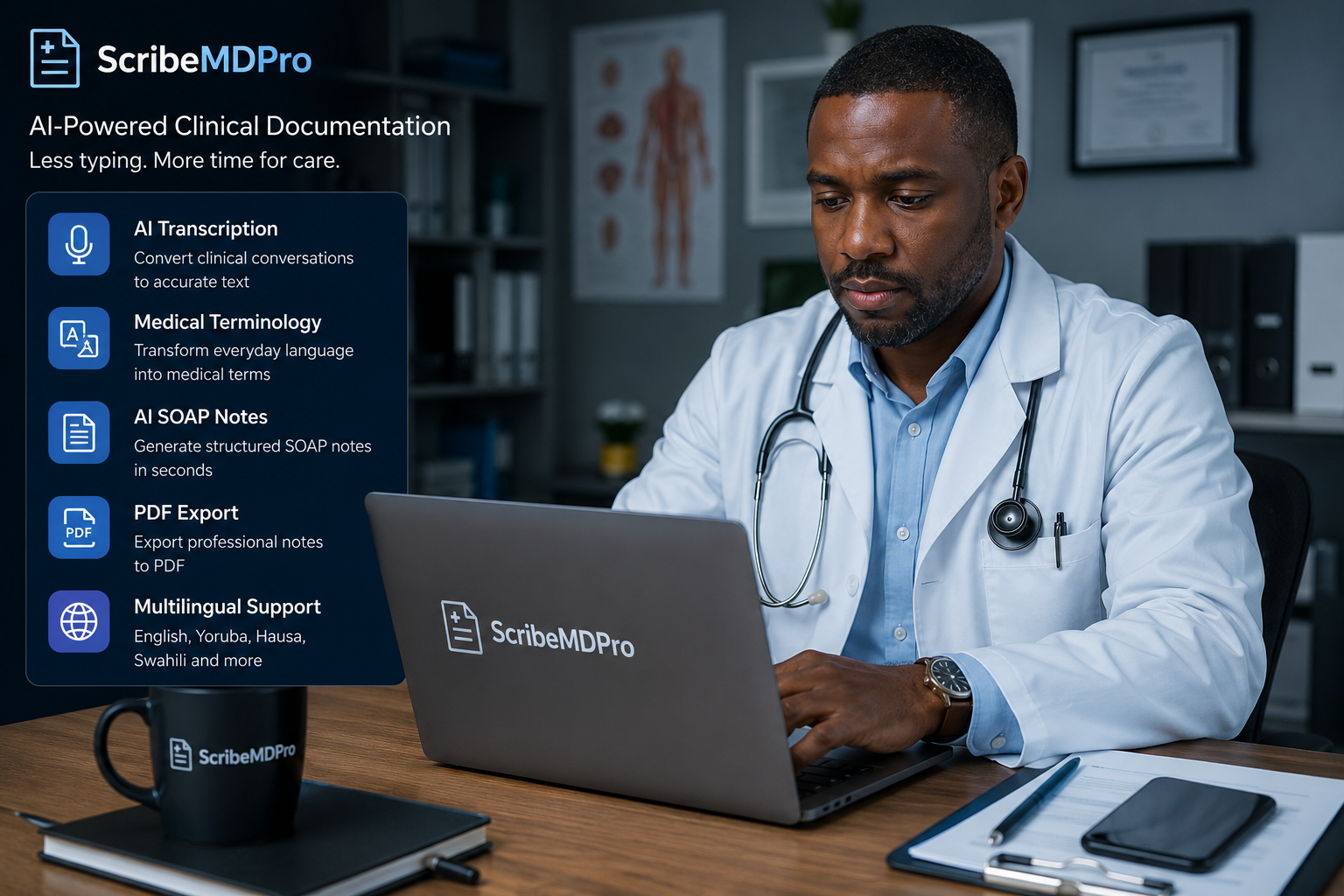
How AI Medical Scribes Can Reduce Clinical Documentation Burden
Introduction
Clinical documentation is an essential part of healthcare. Medical records support continuity of care, communication between healthcare professionals, billing, research, quality improvement, and patient safety.
However, documentation can also become one of the most time-consuming parts of clinical practice.
Healthcare professionals may spend significant time typing notes, organizing information from consultations, and converting conversations into structured clinical documentation.
This is where AI medical scribes are emerging as an important healthcare technology.
What Is an AI Medical Scribe?
An AI medical scribe is a technology that uses artificial intelligence to assist with clinical documentation.
Depending on the platform, an AI scribe can:
•Capture or process clinical conversations •Transcribe spoken information •Identify clinically relevant information •Organize information into structured notes •Generate formats such as SOAP notes •Reduce repetitive documentation tasks
The clinician remains responsible for reviewing the generated documentation before it becomes part of the medical record.
Why Documentation Burden Matters
Clinical documentation has value, but excessive administrative work can interfere with clinical workflows.
A clinician who is simultaneously trying to listen to a patient, remember clinical details, type notes, and navigate an electronic health record may have less attention available for the patient.
AI-assisted documentation aims to shift some of this repetitive work from the clinician to technology.
The goal isn't to remove the clinician from documentation.
The goal is to make documentation less burdensome.
How ScribeMDPro Approaches Clinical Documentation
ScribeMDPro is being developed around this principle.
The platform combines AI-assisted transcription and clinical documentation tools to help transform information from healthcare encounters into structured documentation.
-
AI transcription ScribeMDPro can process spoken information and convert it into text, creating a starting point for clinical documentation.
-
Medical terminology assistance
Healthcare conversations don't always use formal medical terminology.
ScribeMDPro is designed to help transform everyday descriptions into terminology that is more appropriate for clinical documentation.
- SOAP note generation One of the core capabilities of ScribeMDPro is AI-assisted SOAP note generation.
The information can be organized into:
Subjective — information reported by the patient.
Objective — observable or measurable findings.
Assessment — clinical assessment documented by the healthcare professional.
Plan — proposed management and follow-up.
The clinician should review and verify the generated note before using it clinically.
- Professional documentation export
Generated documentation can be exported into professionally formatted PDF files, making it easier to retain or share documentation when appropriate.
- Multilingual accessibility
ScribeMDPro is also being developed with multilingual users in mind, including support for languages such as Yoruba, Hausa, and Swahili.
This is particularly important as healthcare becomes increasingly digital across diverse populations.
AI can make mistakes.
It may misunderstand speech, miss context, incorrectly interpret terminology, or generate information that wasn't actually stated.
For that reason, AI-generated documentation should be treated as a draft requiring professional review, not as an unquestionable medical record.
The clinician remains the final authority.
What Could the Future Look Like?
AI medical documentation is likely to become increasingly integrated into healthcare workflows.
Future systems may assist with:
•Clinical summaries •Medication extraction •Medical coding •Referral letters •Discharge summaries •Patient communication •Clinical analytics •EHR workflows •Multidisciplinary collaboration
The opportunity is not simply to automate note-taking.
It is to create healthcare workflows where technology handles more repetitive administrative tasks while healthcare professionals focus on clinical care.
Conclusion
AI medical scribes represent an important development in healthcare technology.
When implemented responsibly, they can help reduce repetitive documentation work, improve workflow efficiency, and give clinicians more time to focus on patients.
But successful healthcare AI requires more than sophisticated algorithms.
It requires accuracy, privacy, security, transparency, human oversight, and trust.
That is the direction we're taking with ScribeMDPro.
Less documentation burden. More time for care.