From Clinical Notes to Public Health Intelligence: Why Better Documentation Matters for Population Health
Better clinical documentation can strengthen healthcare delivery, health information systems, and population health. This article explores how responsible AI can reduce documentation burden while supporting better health intelligence, especially in Africa.
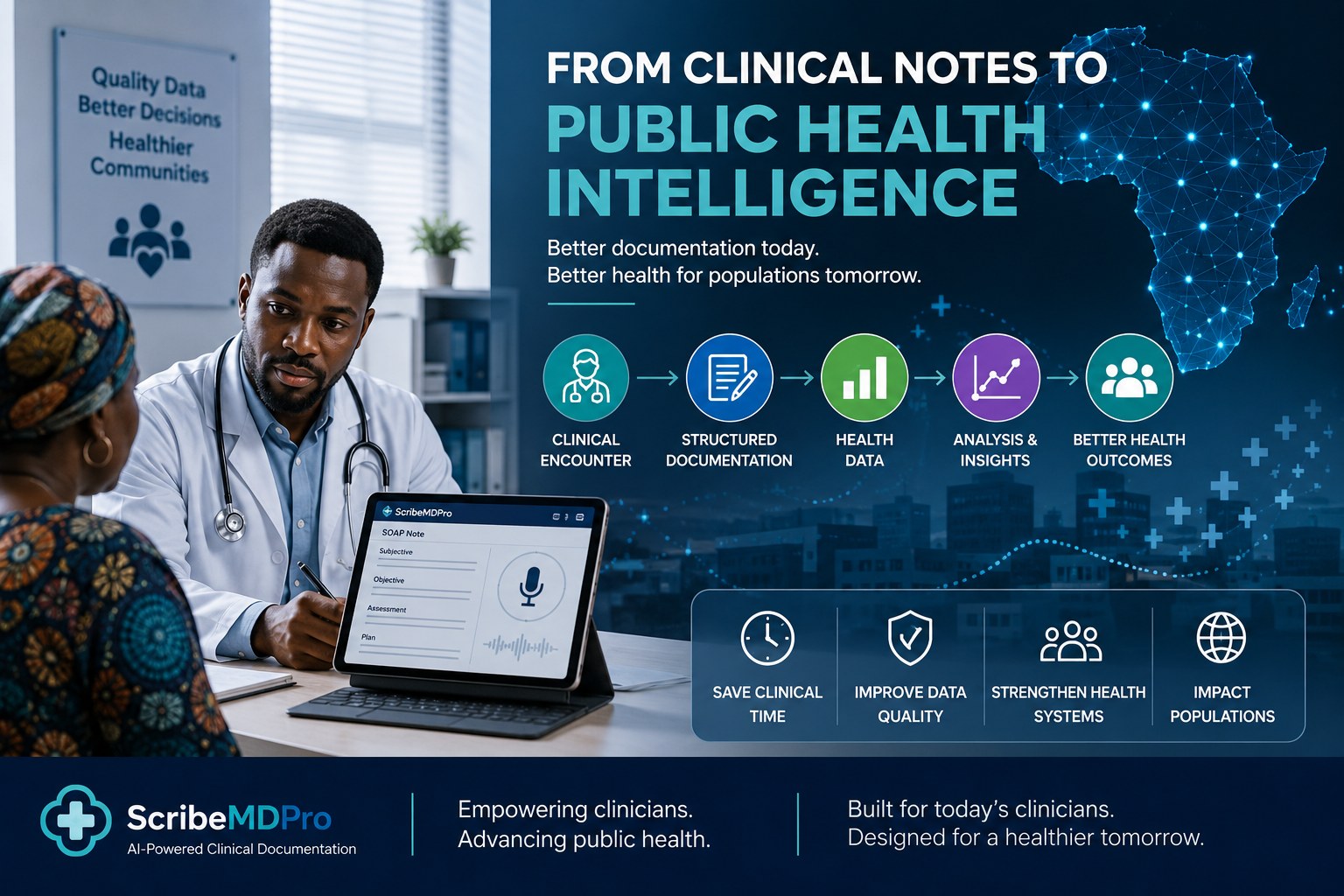
From Clinical Notes to Public Health Intelligence: Why Better Documentation Matters for Population Health
Introduction
The note is more than a note When a clinician documents a patient encounter, it can be easy to think of the resulting clinical note as the end of the process.
The patient was seen. The history was recorded. The assessment was documented. The plan was written.
But from a public-health perspective, that clinical note can represent something much bigger.
It is a small piece of evidence about the health of a population.
Across thousands or millions of healthcare encounters, clinical information can help health systems understand disease patterns, monitor services, identify emerging problems, allocate resources and evaluate whether healthcare interventions are reaching the people who need them.
The World Health Organization recognizes health-facility data as central to clinical management, disease monitoring, health-sector planning and monitoring service coverage and performance.
This creates an important connection between two worlds that are sometimes discussed separately:
clinical care and public health.
And increasingly, that connection is becoming digital.
The hidden value of clinical documentation
Healthcare generates enormous amounts of information every day.
A patient describes symptoms.
A clinician records a history.
A diagnosis is considered.
Laboratory investigations are requested.
Medications are prescribed.
A follow-up plan is created.
Each encounter generates information that can potentially contribute to the broader health-information ecosystem.
The challenge is that information is only useful when it is captured accurately, consistently and in a form that can be used.
Poorly documented information can become difficult to retrieve, interpret or analyze.
Incomplete documentation can leave important details missing. Inconsistent terminology can make comparison difficult.
Fragmented systems can prevent information from moving between healthcare environments.
And when clinicians are overwhelmed by documentation requirements, the quality and timeliness of information can become another concern.
This is why documentation should not be viewed simply as administrative work.
Clinical documentation is part of health information infrastructure.
When documentation becomes a health-system problem
The global healthcare workforce is under enormous pressure.
WHO's current workforce estimates project a global health-worker shortage of approximately 11 million by 2030, with vulnerable countries expected to carry a substantial burden.
This makes efficiency increasingly important.
Healthcare systems cannot simply respond to workforce shortages by asking existing professionals to do more administrative work.
They need to ask a different question:
Which tasks require human clinical expertise, and which repetitive tasks can technology responsibly reduce? Clinical documentation is one area where this question becomes particularly important.
A physician, nurse or other healthcare professional should be able to concentrate on understanding the patient, making clinical decisions and communicating effectively.
Technology should help reduce unnecessary repetition rather than create another layer of work.
From conversation to structured information This is where artificial intelligence has an interesting role.
Imagine a clinical encounter as a pipeline:
Patient encounter → Clinical conversation → Documentation → Structured information → Health data → Analysis → Public-health intelligence
Traditionally, much of the transition from conversation to documentation depends heavily on manual work.
AI-assisted documentation introduces another possibility.
A system can listen to a clinical conversation, generate a transcript and organize relevant information into a structured clinical format.
The clinician can then review, correct and approve the output.
The important principle is:
AI should assist clinical documentation—not replace clinical judgement.
This distinction matters enormously.
An AI-generated note should not automatically become the medical truth.
The clinician remains responsible for reviewing the information, correcting errors and making the final clinical decision.
The public-health opportunity If documentation becomes more structured and efficient, the potential benefits extend beyond the individual consultation.
Better health information can support:
Disease monitoring
Health systems can identify patterns in conditions being seen across facilities and communities.
Service planning
Health managers can better understand healthcare demand and resource requirements.
Health-system performance Routine facility data can help identify gaps in service delivery.
Research
Structured information can support appropriately governed research and analysis.
Outbreak preparedness
Timely health information can contribute to recognizing unusual patterns that warrant further investigation.
WHO's routine health-information strategy specifically emphasizes improving health-data collection, reporting, analysis and use at national, sub-national and community levels.
World Health Organization
The implication is important:
The quality of information generated at the point of care can influence the quality of decisions made further up the health system.
But Africa needs more than imported technology
The African healthcare environment presents a unique opportunity—and a unique responsibility.
Digital-health solutions cannot simply assume that healthcare works the same way everywhere.
Africa has enormous linguistic, cultural, infrastructural and health-system diversity.
A technology designed around one language, one healthcare workflow or one infrastructure environment may not translate effectively into another setting.
This is particularly important for AI.
A genuinely inclusive healthcare AI ecosystem should consider:
•language diversity; •local clinical workflows; •connectivity limitations; •healthcare workforce constraints; •data governance; •affordability; •interoperability; •cultural context.
That is why multilingual capability matters.
For example, ScribeMDPro currently supports English, Hausa, Yoruba and Swahili. That is not the end of the language journey.
It is a beginning.
The broader ambition is to explore how healthcare technology can become more linguistically accessible across diverse healthcare environments.
My public-health perspective My interest in this problem did not begin with software.
It began with public health.
My background in microbiology and infectious-disease work—and my experience volunteering in Neglected Tropical Diseases campaigns—exposed me to a side of healthcare that is sometimes difficult to see from outside the field.
Public health is fundamentally about populations.
But population health is ultimately experienced by individuals.
A person with an infection.
A mother seeking care.
A child requiring treatment.
A community affected by a disease outbreak.
A healthcare professional trying to serve more patients with limited resources.
This is why I have become increasingly interested in the intersection between clinical care, health information, technology and population health.
The question is no longer simply: “How can we build better software?”
It is:
“How can we build technology that helps healthcare systems serve people better?” That is a much harder question.
But it is also a much more meaningful one.
ScribeMDPro: starting with documentation
ScribeMDPro began with a relatively focused problem:
clinical documentation consumes valuable healthcare time.
The platform uses AI-assisted workflows to transform clinical conversations into structured documentation, including transcripts and SOAP notes, while keeping clinicians involved in reviewing and finalizing the output.
But documentation is only the starting point.
The larger vision is to build technology that can eventually contribute to a more efficient, connected and intelligent healthcare ecosystem.
That means thinking beyond the note itself.
It means thinking about:
documentation → structured information → interoperability → analytics → health-system intelligence.
This is also consistent with the broader direction of global digital health.
WHO identifies interoperability, data sharing and evidence-informed digital solutions as important components of digital-health transformation.
We must not sacrifice privacy for intelligence
There is an important caveat.
Better health data does not mean more uncontrolled health data.
Clinical information is deeply sensitive.
Patients should not have to sacrifice privacy for healthcare innovation.
As digital-health systems become more sophisticated, security, access control, auditability, data minimization and responsible governance must be treated as fundamental product requirements.
The goal should never be:
collect everything.
It should be:
collect what is necessary, protect it appropriately, use it responsibly and create meaningful value from it.
This is particularly important as AI becomes increasingly embedded in healthcare workflows.
The future: clinical documentation as infrastructure
Imagine a future where a clinician finishes a consultation and does not have to spend another 20 minutes reconstructing the encounter from memory.
The clinical information is captured.
The documentation is structured. The clinician reviews it.
The appropriate information becomes available to the patient's care team.
And, where legally and ethically appropriate, properly governed aggregated information contributes to understanding broader health trends.
That is a very different vision of clinical documentation.
It transforms documentation from a clerical endpoint into a potential component of the health-information infrastructure.
But getting there will require more than AI.
•It will require: •interoperability; •clinical standards; •responsible AI; •strong privacy protections; •cybersecurity; •appropriate governance; •quality assurance; •clinician trust; •public-health expertise.
Technology alone cannot solve these problems.
People, policy, infrastructure and technology have to move together.
The mission has only begun ScribeMDPro is still an early-stage product.
There is much more to build, test and validate.
There are technical challenges. There are security challenges. There are clinical workflow challenges.
There are questions around scalability, interoperability and responsible AI that deserve serious attention.
But that is precisely why the journey matters.
I am not interested in building technology simply because AI is fashionable.
I am interested in building because I believe technology can be used as a tool for service.
My experience in microbiology and public health taught me that meaningful health improvements rarely come from one intervention alone.
They come from systems.
From people.
From evidence.
From persistence.
And sometimes, from someone deciding that a difficult problem is worth trying to solve.
ScribeMDPro is my attempt to solve one part of that larger problem.
The immediate goal is simple: Give clinicians time back to care.
The longer-term vision is much larger:
Help build healthcare information systems that are more efficient, accessible, intelligent and capable of serving populations better.
The work has only just begun.
A final thought
A clinical note may describe one patient.
But thousands of clinical encounters can tell us something about a community.
Millions can tell us something about a health system.
And when that information is captured responsibly and transformed into knowledge, it can help us make better decisions about the health of populations.
Better documentation is not the whole future of public health.
But it can be one piece of the foundation.
And sometimes, changing the future begins by improving something as ordinary—and as important—as what happens after a patient says:
“Doctor, this is what I've been experiencing.”