The Complete Guide to Clinical Documentation Improvement (CDI) in Modern Healthcare
Discover how Clinical Documentation Improvement (CDI) enhances patient care, documentation quality, and clinical efficiency with the support of AI.
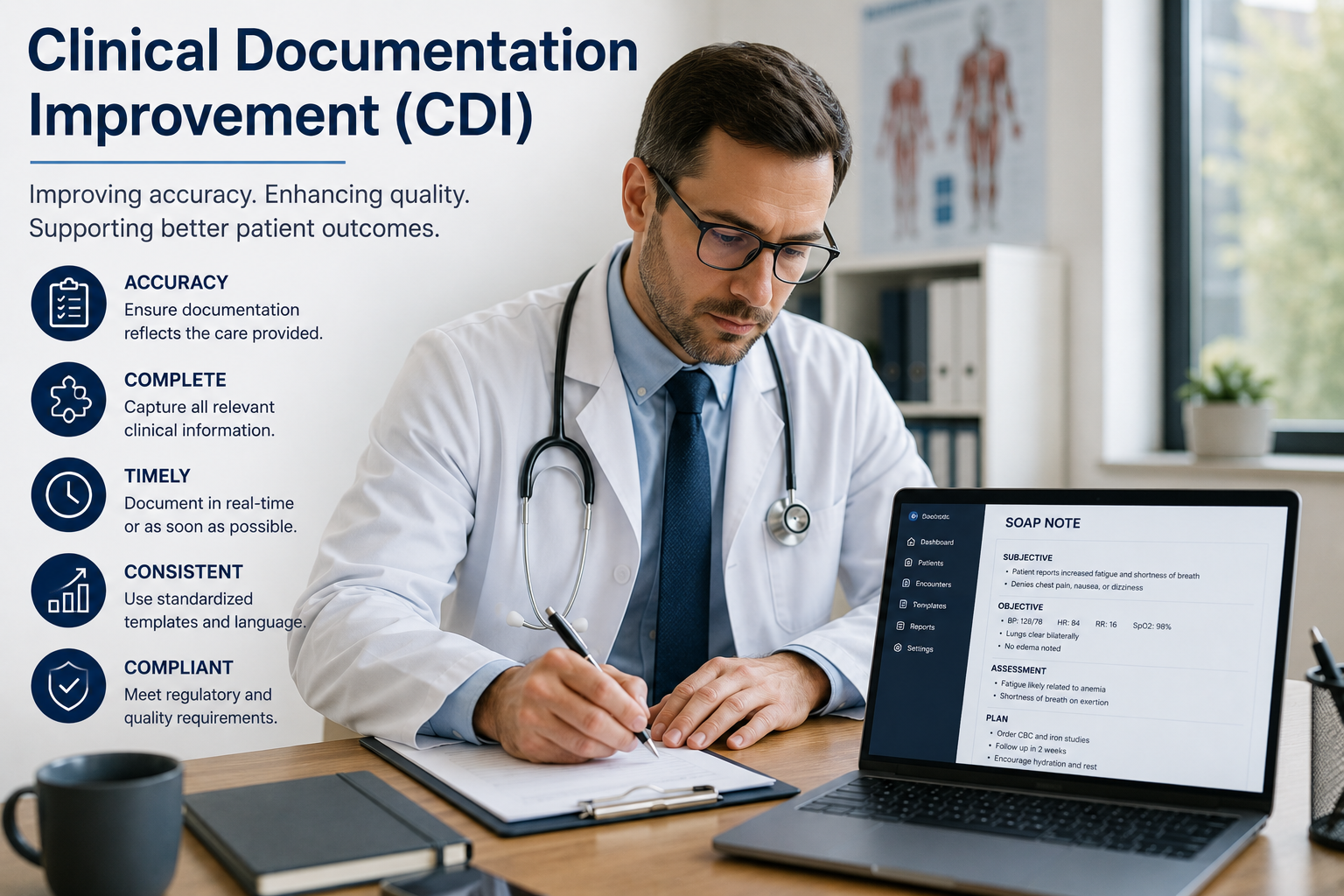
The Complete Guide to Clinical Documentation Improvement (CDI) in Modern Healthcare
Accurate clinical documentation is the foundation of high-quality healthcare. Every diagnosis, treatment decision, and follow-up plan depends on clear, complete, and consistent documentation.
As healthcare becomes increasingly digital, Clinical Documentation Improvement (CDI) has emerged as a critical strategy for improving patient care, communication, and operational efficiency.
What Is Clinical Documentation Improvement (CDI)?
Clinical Documentation Improvement (CDI) is the process of enhancing the quality, accuracy, completeness, and consistency of clinical documentation.
The goal is to ensure that the patient's medical record accurately reflects the care provided.
Effective CDI benefits clinicians, patients, healthcare organizations, and multidisciplinary care teams.
Why Clinical Documentation Matters
Clinical documentation serves multiple purposes:
•Supports clinical decision-making •Improves communication between healthcare providers •Provides an accurate medical history •Supports continuity of care •Facilitates quality improvement initiatives •Creates a reliable legal medical record
Poor documentation can lead to misunderstandings, delays in treatment, and incomplete patient records.
Common Documentation Challenges Healthcare professionals often face:
•Time constraints •Documentation fatigue •High patient volumes •Inconsistent note quality •Missing clinical details •Administrative burden
These challenges contribute to physician burnout and can affect documentation quality.
Key Principles of High-Quality Clinical Documentation
Be Accurate
Document clinical findings exactly as observed.
Be Timely
Complete documentation as soon as possible after the patient encounter.
Be Objective
Record measurable findings while avoiding unnecessary assumptions.
How AI Supports Clinical Documentation Improvement
Modern AI documentation assistants can help clinicians by:
•Structuring SOAP notes •Organizing patient conversations •Reducing repetitive typing •Improving documentation consistency •Accelerating note completion •Supporting standardized workflows
Clinicians remain responsible for reviewing and approving every note.
Best Practices for Healthcare Professionals
To improve documentation quality:
•Use structured note templates •Review notes before signing •Keep documentation concise and clinically relevant •Record important negative findings when appropriate •Update records promptly •Maintain patient confidentiality
The Future of Clinical Documentation
The next generation of documentation systems will include:
•Ambient Clinical Intelligence •Specialty-aware documentation •AI-assisted workflow optimization •Better EHR integration •Real-time clinical documentation support
These technologies aim to reduce administrative workload while maintaining high standards of patient care.
How ScribeMDPro Supports Clinical Documentation Improvement
ScribeMDPro is designed to assist healthcare professionals by transforming clinician-patient conversations into structured, specialty-aware SOAP notes.
The platform helps clinicians reduce documentation time while preserving accuracy, consistency, and clinician oversight.
Our vision is to help healthcare professionals spend more time caring for patients and less time completing paperwork.
Conclusion
Clinical Documentation Improvement is more than an administrative initiative—it is a cornerstone of safe, effective, and patient-centered healthcare.
By combining best documentation practices with responsible AI assistance, clinicians can improve efficiency while maintaining high-quality medical records.