Are AI Medical Scribes HIPAA Compliant? Understanding Privacy, Security, and Patient Trust
Discover how AI medical scribes address privacy, security, and HIPAA compliance while supporting safe and efficient clinical documentation.
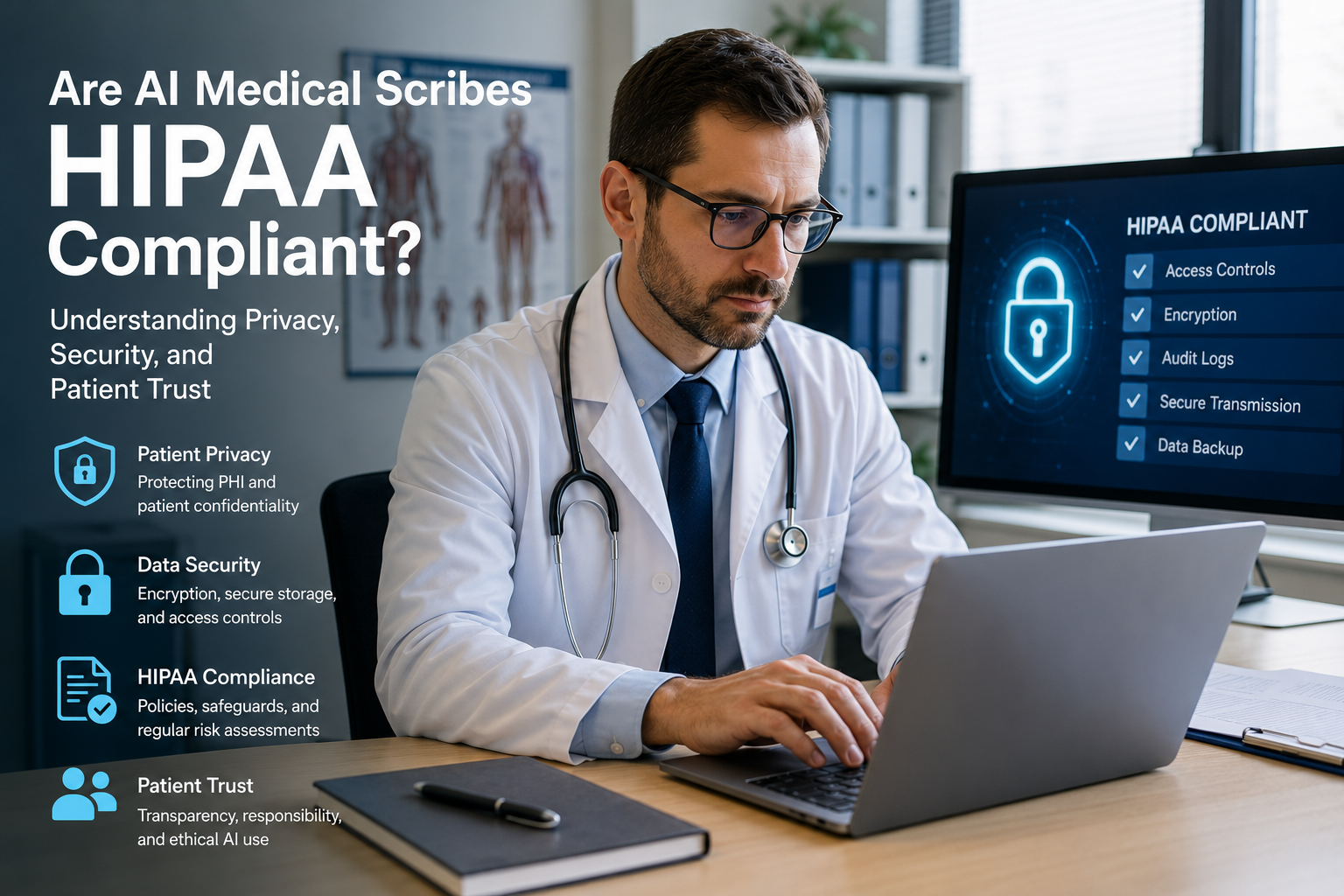
Are AI Medical Scribes HIPAA Compliant? Understanding Privacy, Security, and Patient Trust
Introduction
Artificial Intelligence (AI) medical scribes are transforming clinical documentation by helping healthcare professionals reduce administrative burden and spend more time with patients. However, as AI becomes more integrated into healthcare, one important question continues to arise:
Are AI medical scribes HIPAA compliant?
Patient trust is built on confidentiality. Every healthcare organization must ensure that protected health information (PHI) is handled securely, responsibly, and in accordance with applicable regulations. While AI offers tremendous opportunities, compliance, privacy, and security remain essential considerations before adopting any documentation solution.
Are AI medical scribes HIPAA compliant?
Patient trust is built on confidentiality. Every healthcare organization must ensure that protected health information (PHI) is handled securely, responsibly, and in accordance with applicable regulations. While AI offers tremendous opportunities, compliance, privacy, and security remain essential considerations before adopting any documentation solution.
This guide explains what HIPAA compliance means, how AI medical scribes handle patient information, the security features clinicians should look for, and how healthcare organizations can safely implement AI-assisted documentation.
What Is HIPAA?
The Health Insurance Portability and Accountability Act (HIPAA) is a U.S. federal law that establishes standards for protecting sensitive patient health information.
HIPAA requires healthcare organizations and their business associates to safeguard Protected Health Information (PHI) against unauthorized access, disclosure, or misuse.
Protected information includes:
•Patient names •Dates of birth •Medical record numbers •Diagnoses •Laboratory results •Prescriptions •Clinical notes •Insurance information
What Does HIPAA Compliance Mean for AI Medical Scribes?
An AI medical scribe itself is not automatically HIPAA compliant.
Compliance depends on how the software is designed, deployed, configured, and used.
Healthcare organizations should evaluate:
•How patient data is transmitted •Where information is stored •Whether encryption is used •Who has access to patient records •Audit logging capabilities •Data retention policies •Vendor security practices
How AI Medical Scribes Handle Patient Information
Modern AI medical scribes generally follow a workflow similar to this:
1.Capture clinician-patient conversations. 2.Convert speech into text. 3.Analyze the conversation using AI. 4.Generate a structured clinical note. 5.Allow the clinician to review and approve the documentation. 6.Store or export the finalized note according to organizational policies
Clinician review remains an essential safeguard before documentation becomes part of the patient's permanent medical record.
Essential Security Features to Look For
When evaluating an AI medical scribe, healthcare organizations should consider whether the platform includes:
•End-to-end encryption •Secure user authentication •Role-based access controls •Audit logs •Secure cloud infrastructure •Data backup and recovery •Session timeouts •Secure API connections
These features help reduce security risks and support responsible handling of patient information.
Common Privacy Risks
Potential risks include:
•Unauthorized account access •Weak passwords •Misconfigured permissions •Insecure file sharing •Public Wi-Fi usage •Human error •Poor access management
Many security incidents result from operational mistakes rather than flaws in AI itself.
Best Practices for Healthcare Organizations
Organizations implementing AI documentation solutions should:
•Train staff regularly on privacy practices. •Use strong authentication methods. •Review user permissions frequently. •Encrypt data during transmission and storage. •Maintain detailed audit logs. •Establish clear documentation policies. •Conduct periodic security assessments. •Review vendor security documentation before deployment.
Building Patient Trust
Patients are more likely to accept AI-assisted documentation when healthcare professionals explain:
•Why AI is being used. •How their information is protected. •That clinicians remain responsible for reviewing every note. •That AI supports, rather than replaces, clinical decision-making.
Transparency helps strengthen confidence in digital healthcare technologies.
How ScribeMDPro Approaches Security
ScribeMDPro is designed with the goal of supporting responsible clinical documentation through secure workflows and clinician oversight.
Key principles include:
•Secure user authentication •Structured documentation workflows •Clinician review before finalization •Specialty-aware documentation •Continuous improvement of security and privacy practices
Healthcare organizations should always evaluate whether any software meets their own legal, regulatory, and organizational requirements before deployment.
Frequently Asked Questions
Is every AI medical scribe HIPAA compliant?
No. Compliance depends on the software, deployment environment, vendor practices, and how it is used.
Can AI replace clinician responsibility?
No. Clinicians remain responsible for reviewing, editing, and approving all documentation.
Does encryption make software HIPAA compliant?
Encryption is important, but compliance also requires administrative, technical, and physical safeguards.
Should patients be informed when AI assists documentation?
Healthcare organizations should follow applicable laws, regulations, and institutional policies regarding patient communication and consent.
Conclusion
AI medical scribes can significantly improve documentation efficiency, but privacy and security must always remain priorities.
Healthcare organizations should carefully evaluate security features, vendor practices, and regulatory requirements before implementing AI-assisted documentation.
The future of healthcare depends not only on smarter AI but also on maintaining patient trust through responsible, secure, and transparent technology.