Ambient AI in Healthcare: The Future of Clinical Documentation
Ambient AI is revolutionizing healthcare by documenting patient encounters automatically while clinicians focus on delivering exceptional care. Learn how this technology is reshaping the future of medical documentation.
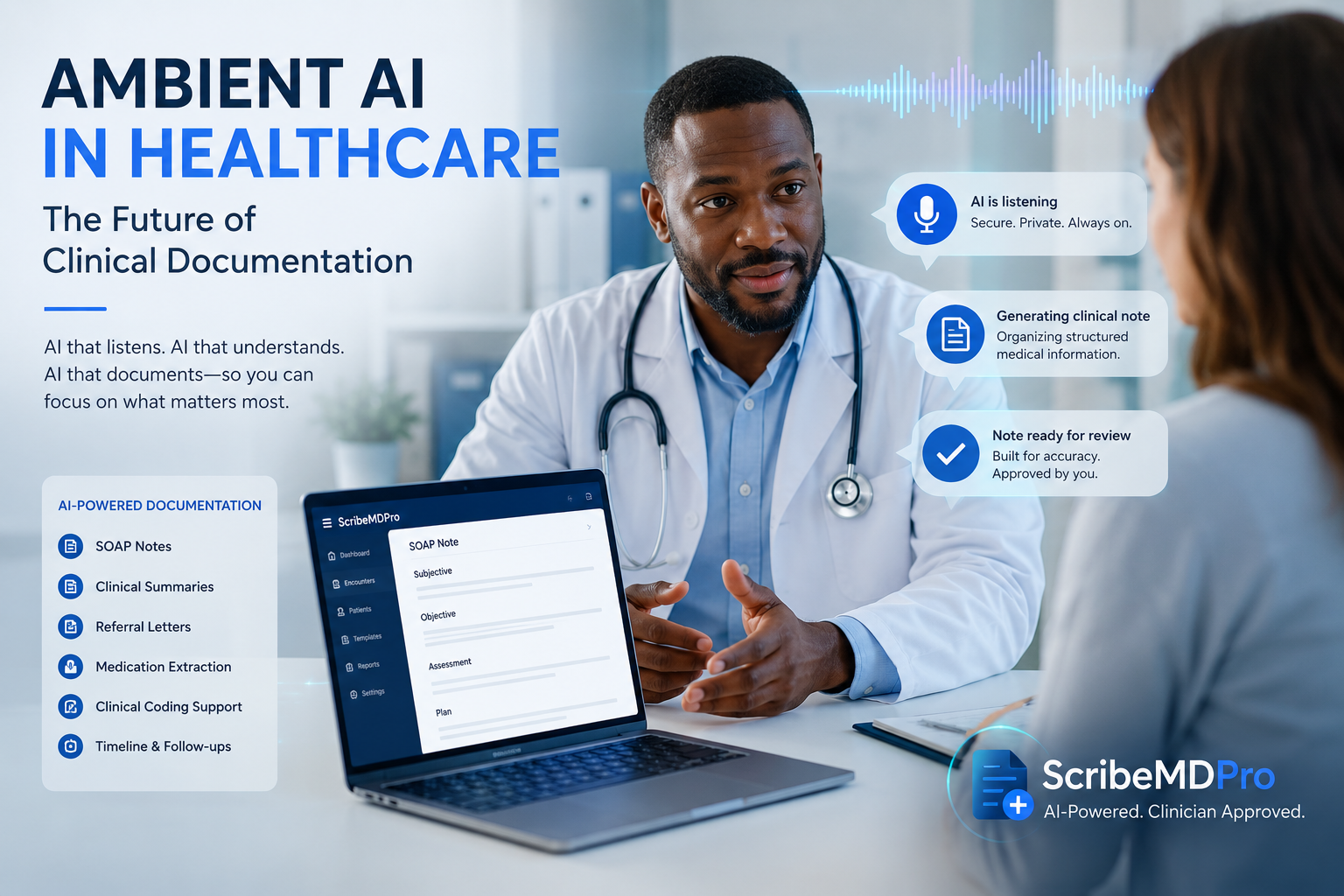
Ambient AI in Healthcare: The Future of Clinical Documentation
Healthcare is entering a new era where artificial intelligence works quietly in the background, supporting clinicians instead of distracting them. One of the most promising innovations driving this transformation is Ambient AI—technology that listens, understands, and documents clinical conversations while healthcare professionals focus on what matters most: their patients.
For decades, documentation has been one of the biggest contributors to physician burnout. Clinicians often spend hours after clinic completing notes, updating electronic health records (EHRs), and managing administrative tasks. Ambient AI is changing that reality by making documentation nearly invisible.
In this article, we explore what Ambient AI is, how it works, its benefits, current challenges, and why it is becoming a cornerstone of modern healthcare.
What Is Ambient AI?
Ambient AI refers to artificial intelligence systems that operate passively in the background of a clinical encounter. Instead of requiring clinicians to type or dictate notes after seeing a patient, Ambient AI captures the conversation during the visit, identifies medically relevant information, and automatically generates structured clinical documentation.
Unlike traditional speech-to-text software, Ambient AI does much more than transcription. It understands medical terminology, clinical context, speaker roles, symptoms, diagnoses, medications, and treatment plans to produce meaningful documentation.
The goal is simple: Allow clinicians to focus on patients—not keyboards.
Why Healthcare Needs Ambient AI
Healthcare professionals face unprecedented documentation demands.
Studies consistently show that physicians spend nearly as much time documenting patient encounters as they do interacting with patients. Administrative work has become one of the leading contributors to burnout across healthcare systems worldwide.
Some of the biggest challenges include:
•Growing documentation requirements •Increasing patient volumes •Complex EHR workflows •Administrative burden •Time spent completing notes after clinic hours •Reduced face-to-face interaction with patients.
Ambient AI addresses these challenges by automating documentation without disrupting clinical workflows.
How Ambient AI Works
Although implementations vary, most Ambient AI platforms follow a similar workflow.
- Passive Listening
The system securely captures the clinical conversation during the consultation using microphones or mobile devices.
Unlike conventional dictation software, clinicians do not need to issue commands or pause the consultation.
- Speech Recognition
Advanced speech recognition converts spoken language into text.
Modern AI systems recognize multiple speakers and distinguish between clinician and patient voices.
- Clinical Understanding
Large language models and clinical AI analyze the conversation to identify:
•Chief complaint •History of present illness Symptoms •Diagnoses •Physical examination findings •Laboratory discussions •Medications •Treatment plans •Follow-up recommendations
Rather than producing raw transcripts, Ambient AI extracts clinically meaningful information.
- Note Generation
The AI organizes the information into structured documentation such as:
•SOAP Notes •Progress Notes •Consultation Notes •Follow-up Notes •Referral Letters •Clinical Summaries
Clinicians then review, edit if necessary, and approve the documentation before it becomes part of the patient's record.
Benefits of Ambient AI
More Time with Patients Perhaps the greatest benefit is improved patient interaction.
Clinicians no longer need to divide their attention between maintaining eye contact and typing notes.
This strengthens communication, trust, and patient satisfaction.
Reduced Physician Burnout
Documentation is a major source of stress.
By reducing after-hours charting, Ambient AI helps clinicians regain valuable personal time and reduces cognitive overload.
Improved Documentation Quality
AI systems generate structured, consistent documentation that reduces missing information and improves note completeness.
Standardized documentation also supports quality improvement initiatives.
Faster Clinical Workflows
Documentation that once required several minutes—or even hours—can now be completed within seconds after the consultation.
This improves clinic efficiency while allowing providers to see more patients without sacrificing quality.
Enhanced Accuracy
Modern AI systems understand clinical terminology and context better than traditional transcription software.
Rather than producing word-for-word transcripts, they summarize relevant medical information in a clinically appropriate format.
Impact on Different Healthcare Professionals
Ambient AI benefits nearly every member of the healthcare team.
Physicians
•Reduced documentation burden •Improved workflow •Less after-hours charting
Nurses
•Faster nursing documentation •Better care coordination •Reduced administrative workload
Specialists
•Specialty-specific documentation •Faster consultation notes •More detailed summaries
Allied Health Professionals
•Improved record keeping •Standardized documentation •Faster reporting
Patient Benefits
Although Ambient AI is designed primarily for clinicians, patients also benefit significantly.
Patients experience:
•Better eye contact •More engaging conversations •Longer meaningful interaction •Improved communication •Better continuity of care
When clinicians spend less time documenting, patients receive more attention.
Privacy and Security Considerations
Healthcare data is among the most sensitive forms of personal information.
Ambient AI platforms must prioritize:
•End-to-end encryption •Secure cloud infrastructure •Access controls •Data minimization •Audit trails •Regulatory compliance •Patient consent where required
Healthcare organizations should evaluate AI vendors carefully before deployment.
Challenges of Ambient AI
Despite its enormous potential, Ambient AI is not without limitations.
Some challenges include:
Background Noise
Busy clinical environments may affect speech recognition accuracy.
Medical Complexity
Rare diseases, unusual terminology, or highly specialized discussions may require clinician review.
Human Oversight
AI-generated documentation should always be reviewed by qualified healthcare professionals before becoming part of the permanent medical record.
Ambient AI assists clinicians—it does not replace clinical judgment.
The Future of Ambient AI
Ambient AI is expected to become a standard feature of clinical practice over the coming years.
Future developments may include:
•Real-time clinical decision support •Automated ICD-10 and ICD-11 coding •Medication safety checks •Intelligent referral generation •Predictive clinical insights •Automated quality reporting •Seamless EHR integration •Multilingual clinical documentation
As AI models continue to improve, clinicians will spend even less time on administrative work and more time delivering patient-centered care.
How ScribeMDPro Fits into This Vision
At ScribeMDPro, we believe healthcare technology should simplify clinical practice rather than complicate it.
Our platform is built to help clinicians document encounters efficiently using AI-powered tools designed for modern healthcare workflows.
Current capabilities include:
•AI-powered clinical transcription •SOAP note generation •Clinical summaries •Referral letters •Medication extraction •Clinical coding support •Documentation quality analysis •Timeline intelligence •Productivity tools •Multilingual support, including Yoruba, Hausa, Igbo, and Swahili
As we continue developing ScribeMDPro, our vision is to deliver intelligent clinical documentation solutions that save time, reduce burnout, and improve healthcare delivery.
Conclusion
Ambient AI represents one of the most significant advances in healthcare technology in recent years.
By automating clinical documentation, healthcare professionals can spend less time managing paperwork and more time caring for patients.
While human oversight remains essential, Ambient AI has the potential to transform clinical workflows, improve documentation quality, and reduce administrative burden across healthcare systems.
The future of healthcare is not about replacing clinicians with AI—it is about empowering them with tools that allow them to practice medicine more effectively.
As Ambient AI continues to evolve, platforms like ScribeMDPro are committed to helping clinicians embrace this future with confidence, efficiency, and patient-centered innovation.