AI SOAP Note Generators: How AI Can Transform Clinical Conversations Into Structured Documentation
AI SOAP note generators can help clinicians transform unstructured clinical conversations into organized documentation. Learn how the technology works, its benefits and limitations, and why clinician review remains essential.
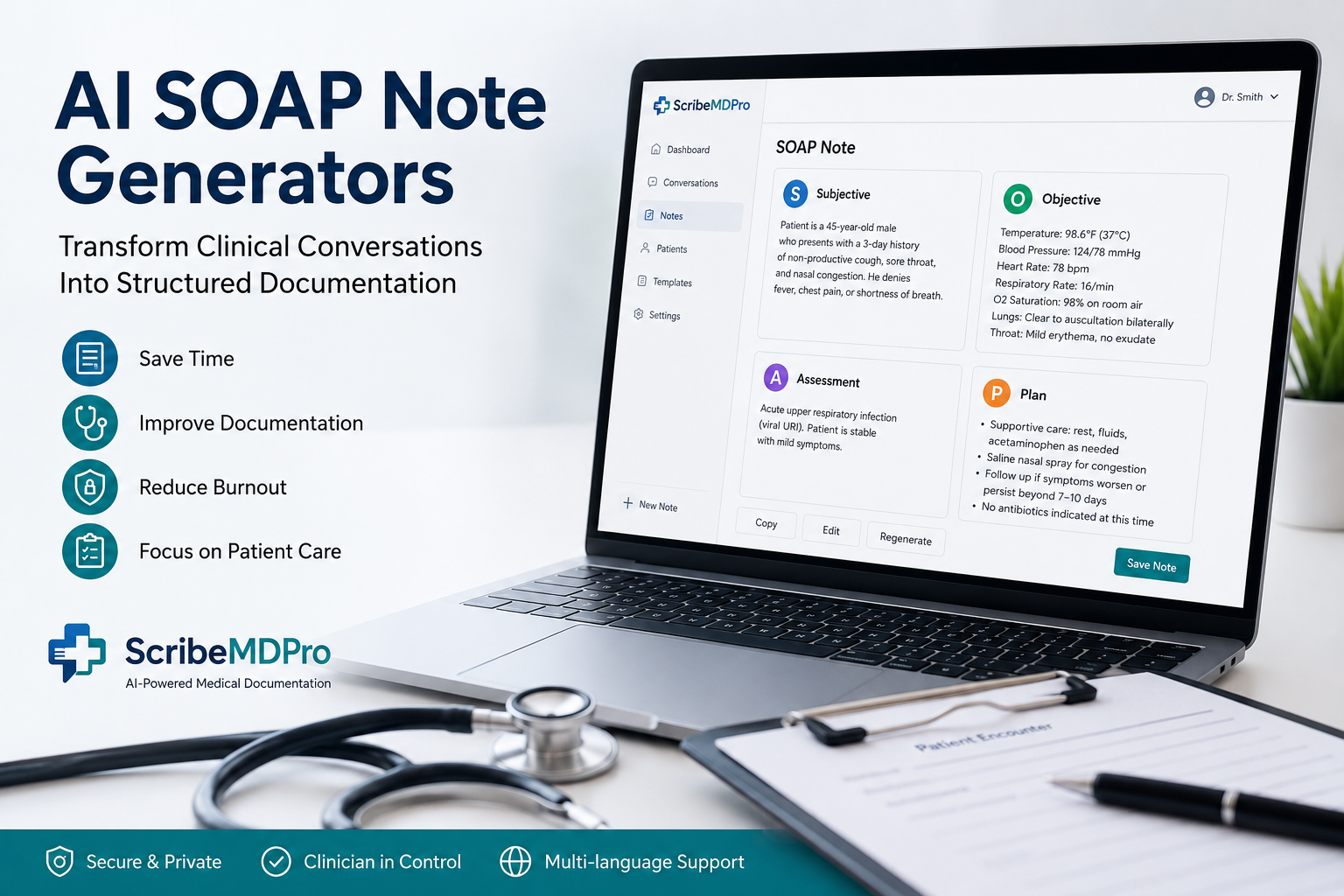
AI SOAP Note Generators: How AI Can Transform Clinical Conversations Into Structured Documentation
Introduction
A physician's work does not end when the patient leaves the consultation room.
After the conversation, there is often another important task: documenting what happened.
Symptoms need to be recorded.
Relevant history needs to be organized. Examination findings need to be documented.
Clinical impressions and plans need to be captured accurately.
For many healthcare professionals, creating these notes can become a repetitive and time-consuming part of the clinical workflow.
This is where an AI SOAP note generator can potentially help. AI-powered documentation systems can analyze clinical conversations or other source information and organize relevant details into a structured SOAP note.
The objective isn't to replace the physician.
Instead, the technology can help create a preliminary document that the clinician can review, correct, and approve.
But how does an AI SOAP note generator actually work, and what should healthcare professionals consider before using one?
What Is a SOAP Note?
SOAP is one of the most recognizable structures used for clinical documentation.
The acronym represents four components:
S — Subjective
This section describes information reported by the patient.
It may include:
•Chief complaint •Symptoms •History of present illness •Relevant medical history •Patient-reported concerns •Medication information reported during the consultation
O — Objective This section contains observable or measurable clinical information.
Examples may include:
•Vital signs •Physical examination findings •Laboratory results •Imaging findings •Other objective observations
An important principle for AI-generated documentation is that objective information should not be invented.
If a blood pressure measurement wasn't provided in the source material, an AI system should not create one.
A — Assessment
The assessment summarizes the clinician's documented clinical impression.
An AI system should distinguish between information actually documented by the clinician and information it might infer.
P — Plan
The plan records the documented next steps.
Depending on the consultation, this might include:
•Treatment discussed •Medication instructions •Investigations •Referrals •Follow-up •Patient education
If a plan wasn't discussed, the system should not invent one.
Why SOAP Notes Can Become Time-Consuming
SOAP notes are structured, but the conversations that produce them usually aren't.
A patient might begin with one symptom, move to another concern, provide relevant history several minutes later, and then discuss medications near the end of the consultation.
The physician has to convert that naturally occurring conversation into a logical clinical structure.
Traditionally, this may involve:
Listen → Remember → Organize → Type → Review → Correct → Finalize
The repetitive nature of this process is one reason AI-assisted documentation has attracted interest.
Instead of beginning with a blank document, clinicians can potentially begin with an AI-generated draft.
The workflow becomes:
Consultation → AI-generated draft → Clinician review → Final documentation
That difference can be significant when repeated across many consultations.
What Is an AI SOAP Note Generator?
An AI SOAP note generator is a software system that uses artificial intelligence to help convert clinical information into the four-part SOAP structure.
Depending on the platform, the source information might come from:
•A recorded clinical conversation •A transcription •Dictated notes •Manually entered information •Other structured clinical data
The AI analyzes the available information and attempts to identify relevant details.
It then organizes those details into:
•Subjective •Objective •Assessment •Plan
The result is generally intended to be a draft, not an automatically approved medical record.
That distinction is extremely important.
How AI Turns a Clinical Conversation Into a SOAP Note
Consider a simplified example.
A patient tells a physician:
"I've had a dry cough for about two weeks. It gets worse at night. I haven't had a fever or chest pain. Sometimes I feel slightly short of breath when climbing stairs."
The physician asks additional questions and discusses the patient's history.
An AI documentation system can analyze the conversation and identify relevant information. The information might then be organized as:
Subjective
Patient reports a two-week history of predominantly dry cough, worse at night, with occasional shortness of breath on exertion. Patient denies fever and chest pain.
Objective
Only objective findings explicitly documented during the encounter should appear here. Assessment The clinician's documented clinical impression, if provided.
Plan
The treatment or follow-up plan documented during the consultation.
The important part is that the AI is organizing information, not creating facts that weren't present.
The Four Components of AI-Generated SOAP Notes
A reliable AI SOAP note workflow should treat each SOAP component differently.
- Subjective Information AI can help identify patient-reported information from a conversation.
This can reduce the need for clinicians to manually locate every symptom or historical detail.
However, context matters. The system should distinguish between:
"The patient has a fever."
and: "The patient says they did not have a fever."
Those statements have completely different meanings.
Clinical documentation AI therefore needs to preserve context and negation carefully.
- Objective Information
Objective information requires particular caution.
AI should only document measurable or observed information that is actually available.
For example:
Source: "Blood pressure today was 128/78."
The system can document that measurement.
But if blood pressure was never mentioned, the AI should not generate:
"BP: 128/78 mmHg."
This is one reason human review remains essential.
- Assessment
The assessment section can be particularly sensitive.
AI systems may recognize patterns in clinical language, but recognizing a possible condition is not the same as establishing a diagnosis.
A responsible documentation workflow should avoid presenting unsupported AI-generated assumptions as confirmed diagnoses.
The system should prioritize what the clinician actually documented.
- Plan
The plan should reflect what was actually discussed or documented. If the physician says: "We'll order a chest X-ray and review the results next week." That can be incorporated into the plan.
But if no follow-up plan was discussed, the AI shouldn't invent one simply because a particular condition would normally have one.
Benefits of AI SOAP Note Generation
When appropriately implemented, AI SOAP note generation can offer several potential benefits.
Reduced repetitive typing Clinicians may spend less time manually converting conversations into structured notes.
Faster first drafts Instead of starting from a blank document, the physician can begin with an organized draft.
Structured documentation AI can help arrange information consistently under the appropriate SOAP headings.
Workflow support A well-designed system can reduce the number of repetitive documentation steps in a clinical workflow.
More time for review Instead of spending all available time creating the initial draft, clinicians can focus more attention on reviewing and improving it.
Potential reduction in after-hours documentation
If documentation becomes more efficient, some clinicians may be able to reduce the amount of administrative work that extends beyond clinical hours.
However, actual time savings will vary depending on the clinician, specialty, workflow, consultation volume, and quality of the generated output.
AI SOAP Notes vs Manual Documentation
Manual documentation gives clinicians complete control over what they write, but it can also be time-consuming.
AI-assisted documentation changes the starting point.
Traditional workflow
Patient consultation ↓ Physician manually creates note ↓ Review ↓ Final note
AI-assisted workflow
Patient consultation ↓ AI generates draft ↓ Physician reviews and edits ↓ Final note
The second workflow doesn't eliminate the clinician.
It changes where the clinician spends their time.
Instead of spending most of the effort producing the first draft, the clinician can potentially spend more time checking, correcting, and finalizing the documentation.
The Biggest Challenge: Accuracy AI-generated medical
documentation must be treated differently from ordinary AI-generated text.
A mistake in a marketing article is inconvenient.
A mistake in clinical documentation can have much more serious consequences.
Potential problems include:
•Missing information •Incorrect interpretation •Incorrect attribution •Misunderstood negation •Fabricated details •Incorrect terminology •Incorrect assessment •Missing follow-up information
This is why healthcare AI should not be marketed as automatically perfect.
The right question isn't:
"Can AI generate a medical note?" It clearly can.
The more important question is:
"Can AI generate a useful draft that a clinician can efficiently verify and correct?"
That is a much more meaningful standard.
Why Clinician Review Is Essential AI-assisted documentation should follow a human-in-the-loop approach.
A practical workflow is:
AI generates The system processes the available information and produces a draft.
Clinician reviews The healthcare professional checks whether the note accurately represents the encounter.
Clinician edits Errors, omissions, or inappropriate wording are corrected.
Clinician approves The final documentation is accepted according to the organization's workflow.
This preserves clinical oversight.
AI can assist with documentation, but clinical responsibility should remain with appropriately qualified healthcare professionals.
Privacy and Security Considerations
Clinical conversations can contain highly sensitive information.
Before adopting an AI SOAP note generator, healthcare organizations should understand how information is handled.
Important questions include:
•Where is the information processed? •Where is it stored? •Who has access? •How long is it retained? •Is information used for model training? •What third-party services process the data? •What security controls are implemented? •What privacy and regulatory requirements apply to the organization's location?
Healthcare organizations should evaluate these questions according to their specific legal, regulatory, and operational requirements.
Public demonstrations should use fictional clinical scenarios rather than real patient information.
How to Choose an AI SOAP Note Generator Not every AI documentation platform will provide the same experience. Healthcare professionals should consider several factors.
- Accuracy
Does the generated note faithfully reflect the source information?
- Ease of editing
Can clinicians quickly correct the draft?
- Workflow integration
Does the system simplify documentation or create additional steps?
- Transparency
Does the vendor clearly explain how data is processed?
- Security
Are appropriate technical safeguards implemented?
- Reliability
What happens when the AI provider or another external service becomes unavailable? 7. Customization
Can documentation formats be adapted to different clinical workflows?
- Multilingual capability
Can the system support the languages used by the healthcare professionals and patients it serves?
- Scalability
Can the platform support individual clinicians as well as larger healthcare teams?
These questions can help organizations evaluate AI documentation based on actual clinical needs rather than marketing claims.
How ScribeMDPro Approaches AI-Assisted SOAP Notes
ScribeMDPro is being developed around the idea that AI should assist medical documentation rather than replace clinical judgement.
The platform is designed to help transform clinical information into structured documentation, including SOAP notes and clinical summaries.
The broader workflow is straightforward:
Clinical conversation ↓ AI processing ↓ Structured documentation ↓ Clinician review ↓ Final note
The goal is to reduce repetitive documentation work while keeping the healthcare professional in control of the final output.
ScribeMDPro is also being developed with multilingual healthcare environments in mind, supporting languages including English, Yoruba, Hausa, and Swahili etc.
As with any AI-assisted documentation technology, generated content should be reviewed and verified by a qualified healthcare professional before clinical use.
The Future of AI SOAP Note Generation
AI SOAP note generation is part of a much larger movement toward AI-assisted clinical documentation.
Future systems may increasingly help clinicians with:
•Clinical summaries •Referral letters •Discharge documentation •Medical transcription •Structured documentation •Administrative correspondence •Information extraction •Documentation quality checks
But the most successful systems are unlikely to be those that simply generate the most text.
They will be the systems that integrate naturally into clinical workflows.
The ideal AI assistant should reduce friction rather than create another administrative task.
It should understand context, preserve important details, avoid fabricating information, and make it easy for clinicians to review the result.
Conclusion
An AI SOAP note generator can potentially change how clinicians approach documentation.
Instead of beginning with a blank page after every consultation, physicians can begin with an AI-generated draft that organizes relevant information into the familiar Subjective, Objective, Assessment, and Plan structure.
The potential benefits include reduced repetitive typing, faster documentation workflows, and more efficient clinical note creation.
But AI-generated documentation must be approached carefully.
Accuracy matters. Privacy matters. Security matters.
Clinician review matters.
The goal should not be to replace the physician's judgement.
It should be to give healthcare professionals a better starting point.
That's the opportunity behind AI-assisted clinical documentation—and the reason platforms such as ScribeMDPro are exploring how AI can make medical documentation more efficient while keeping clinicians firmly in control.
Want to see AI-assisted medical documentation in action?
Explore ScribeMDPro and see how clinical conversations can be transformed into structured medical documentation.
Try ScribeMDPro → https://scribemd.site
Demo and generated documentation should be reviewed by a qualified healthcare professional before clinical use.