AI Medical Scribes vs Traditional Medical Scribes: Which Is Better for Modern Healthcare?
Discover the differences between AI medical scribes and traditional medical scribes, and learn which solution best supports modern clinical documentation.
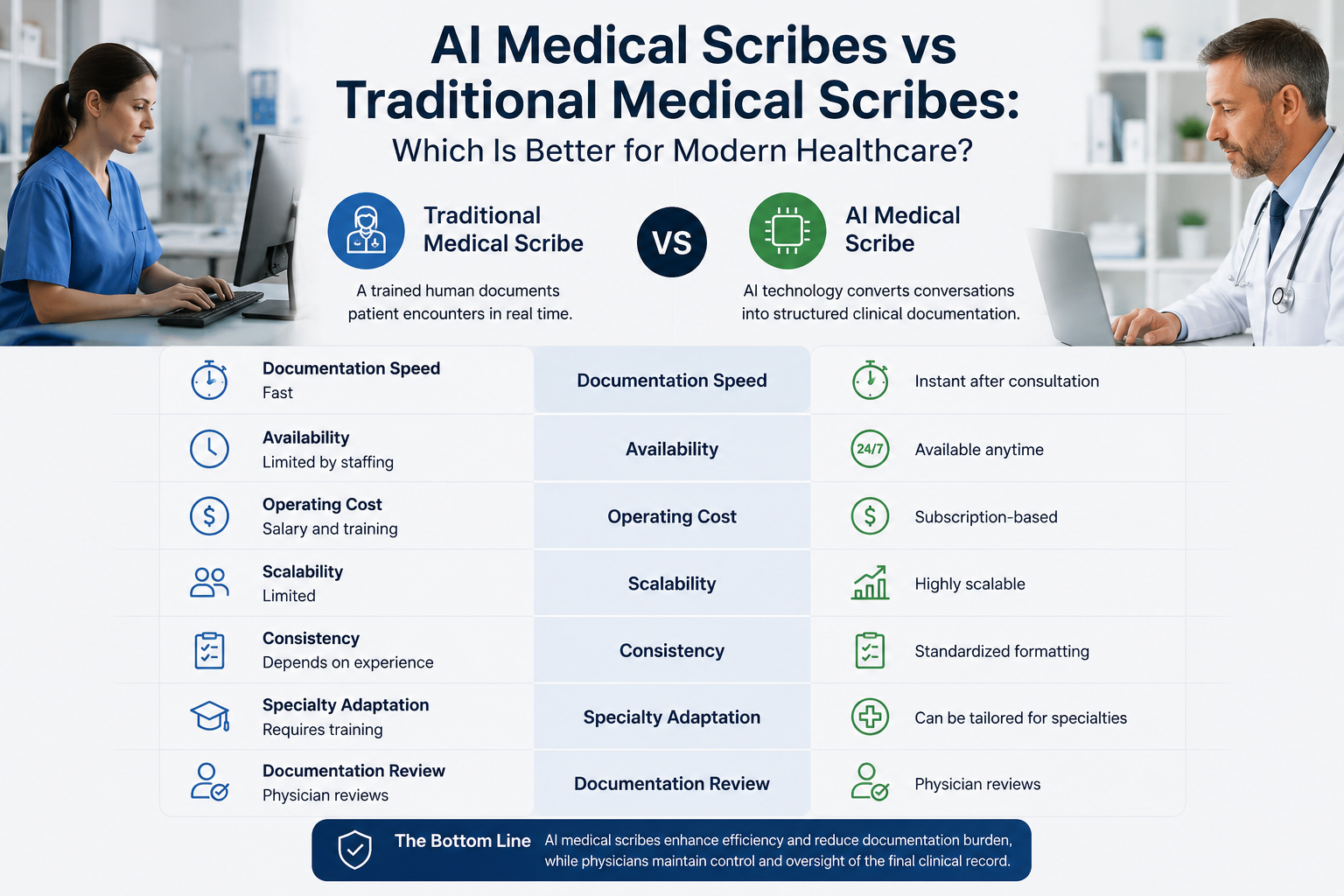
AI Medical Scribes vs Traditional Medical Scribes: Which Is Better for Modern Healthcare?
Clinical documentation has always been an essential part of healthcare. Traditionally, many physicians relied on human medical scribes to document patient encounters. Today, artificial intelligence is changing that workflow by introducing AI-powered medical scribes.
But how do the two compare?
Let's examine the differences.
What Is a Traditional Medical Scribe?
A traditional medical scribe is a trained individual who accompanies a clinician during patient encounters and documents the consultation in real time.
Responsibilities often include:
•Writing clinical notes •Updating electronic health records (EHRs) •Recording diagnoses •Documenting procedures •Preparing documentation for physician review
Human scribes remain valuable in many healthcare settings but come with staffing and operational considerations.
What Is an AI Medical Scribe?
An AI medical scribe uses speech recognition and artificial intelligence to convert clinician-patient conversations into structured clinical documentation.
Instead of relying on another person in the examination room, clinicians can use AI to generate organized SOAP notes that they review before finalizing.
AI Medical Scribe Vs Traditional Medical Scribe
Traditional Medical Scribe
•Documentation Speed: Fast •Availability: Limited by staffing •Operating Cost: Salary and training •Scalability: Limited •Consistency: Depends on experience •Specialty Adaptation: Requires training •Documentation Review: Physician reviews
AI Medical Scribe
•Documentation Speed: Instant after consultation •Availability: Available anytime •Operating Cost: Subscription-based •Scalability: Highly scalable •Consistency: Standardized formatting •Specialty Adaptation: Can be tailored for specialties •Documentation Review: Physician reviews
Advantages of Traditional Medical Scribes
Human scribes provide:
•Contextual understanding •Ability to ask clarifying questions •Adaptability in complex situations •Personal interaction with clinicians
Advantages of AI Medical Scribes
AI medical scribes offer several practical benefits:
Reduced documentation burden
Clinicians spend less time typing and more time caring for patients.
Faster turnaround
Clinical notes can be generated within minutes.
Consistent documentation
Standardized SOAP note formatting helps improve documentation quality.
Improved workflow
Clinicians can complete documentation before leaving the clinic instead of after hours.
Lower long-term operational costs
AI can reduce ongoing documentation expenses while remaining available around the clock.
Are AI Medical Scribes Replacing Human Scribes?
Not entirely.
AI is best viewed as an assistive technology.
Clinicians remain responsible for reviewing, editing, and approving every note before it becomes part of the patient's medical record.
Human clinical judgment cannot be replaced.
Choosing the Right Solution
The ideal documentation solution depends on:
•Practice size •Patient volume •Clinical specialty •Documentation requirements Budget •Existing workflow
Many practices are increasingly exploring AI-assisted documentation as part of their digital transformation strategy.
How ScribeMDPro Supports Modern Documentation
ScribeMDPro was designed to help clinicians reduce documentation time while maintaining control over the final clinical record.
Key capabilities include:
•Ambient conversation capture •Structured SOAP note generation •Specialty-aware documentation •Secure workflows •Clinician review before finalization
The goal is simple: help healthcare professionals spend more time with patients and less time on paperwork.
Final Thoughts
Both traditional and AI medical scribes play important roles in healthcare.
As AI continues to mature, many organizations are adopting AI-assisted documentation to improve efficiency while preserving clinician oversight and accountability.