The Hidden Cost of Clinical Documentation: How AI Medical Scribes Could Give Physicians Their Time Back
AI medical scribes are helping reshape clinical documentation by reducing repetitive administrative work and turning clinical conversations into structured medical notes. Explore how AI-assisted documentation could reduce physician workload while keeping accuracy, privacy, and clinician review at the center.
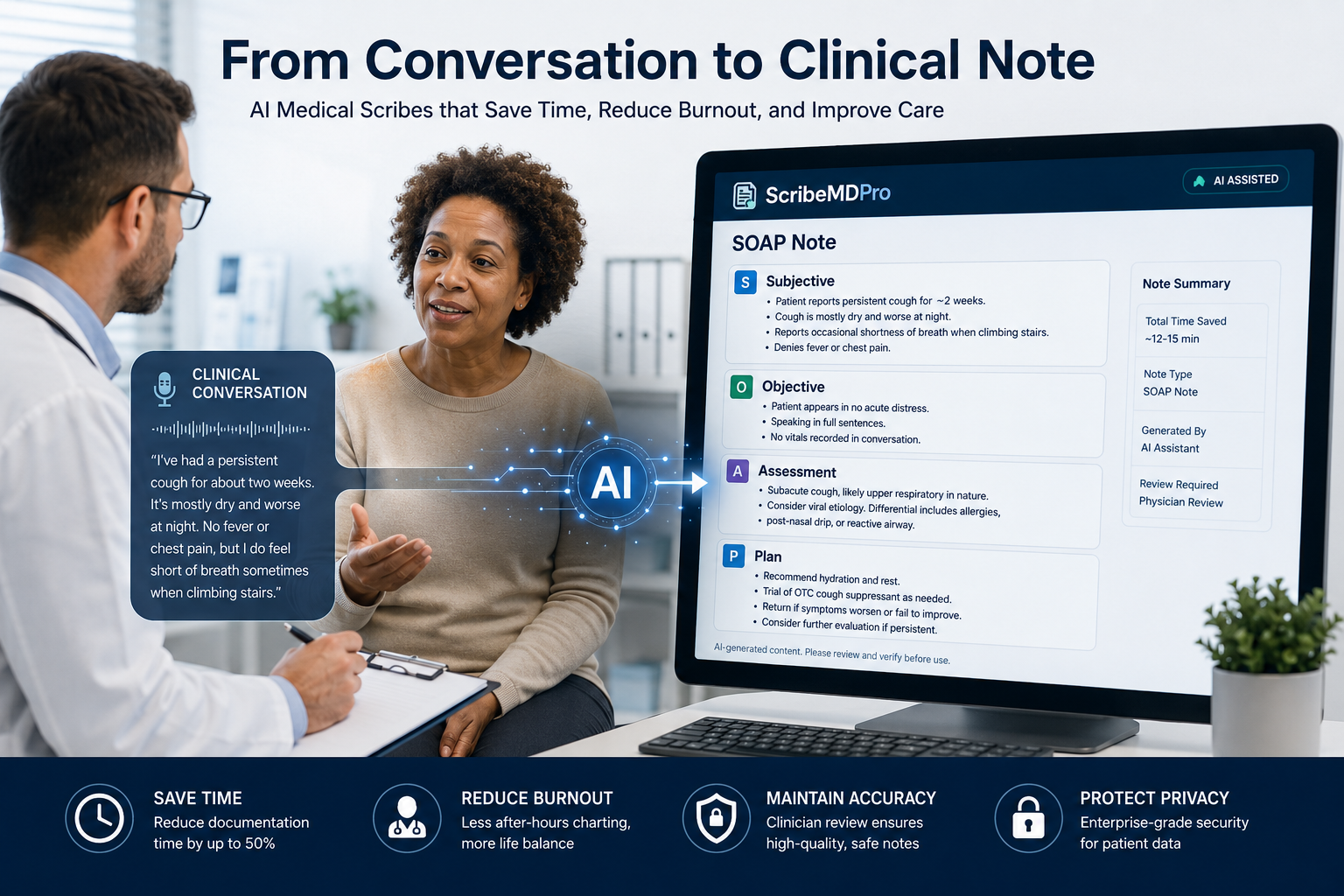
The Hidden Cost of Clinical Documentation: How AI Medical Scribes Could Give Physicians Their Time Back
Introduction
When the Workday Doesn't End After the Patient Leaves For physicians, the end of a clinic session does not necessarily mean the end of the working day.
There may still be patient notes to complete, consultation details to organize, diagnoses and plans to document, referrals to prepare, and electronic health records to update.
Clinical documentation is essential. It supports continuity of care, communication between healthcare professionals, medical decision-making, billing, quality improvement, research, and legal documentation.
The problem is not documentation itself.
The problem is the amount of time and cognitive effort required to produce it.
As healthcare becomes increasingly digital, physicians can find themselves spending significant portions of their working day interacting with electronic health records rather than interacting with patients.
This is one reason interest in the AI medical scribe has grown rapidly.
AI-powered documentation tools are designed to help transform clinical conversations and other information into structured medical documentation.
Instead of requiring clinicians to manually reconstruct every relevant detail after a consultation, an AI system can assist with organizing the information into a usable format.
But can AI actually give physicians their time back? The answer is potentially yes—but only when the technology is implemented responsibly, securely, and with appropriate clinician oversight.
The Documentation Burden Behind Physician Burnout Physician burnout is a complex problem with many contributing factors.
Workload, staffing pressures, administrative responsibilities, emotional demands, long hours, organizational culture, and clinical complexity can all contribute.
Documentation is only one part of that picture.
However, it is an important part because documentation frequently extends beyond direct patient care.
A physician may finish seeing patients but still have charts to complete.
That creates a difficult situation:
The patient visit ends, but the documentation workload continues.
Over time, this can contribute to a cycle in which physicians spend more time working after clinical hours.
The result isn't simply lost time.
It can also mean less time for rest, family, professional development, research, or other activities outside clinical work.
This is where AI-assisted clinical documentation becomes particularly interesting.
What Is an AI Medical Scribe?
An AI medical scribe is a software system designed to assist with clinical documentation.
Depending on the system, an AI medical scribe may help transform information such as:
•Patient-provider conversations •Dictated clinical notes •Clinical summaries •Medical histories •Consultation information
into structured documentation.
One common output is the SOAP note.
SOAP stands for:
•Subjective •Objective •Assessment •Plan
A traditional documentation workflow might require a physician to listen, remember, organize, type, edit, and format information manually.
An AI-assisted workflow can potentially automate parts of that process.
The important word is assist.
An AI medical scribe should not be viewed as a replacement for clinical judgement.
Instead, it can serve as a documentation assistant that helps clinicians produce a first draft that can then be reviewed and corrected.
From Conversation to Clinical Documentation
Imagine a typical consultation. A patient explains their symptoms.
The physician asks questions, discusses medical history, performs an examination, reviews relevant information, and discusses a treatment or follow-up plan.
Traditionally, the physician must later convert that interaction into structured documentation.
An AI medical documentation workflow can approach the process differently:
Clinical conversation ↓ AI processing ↓ Relevant information extracted ↓ Structured documentation ↓ Clinician review ↓ Final clinical note
The objective is not to remove the physician from the documentation process.
The objective is to reduce the amount of repetitive administrative work required to produce the first draft.
How AI Clinical Documentation Could Reduce Workload
The potential benefit of AI medical scribes comes from reducing repetitive documentation tasks.
For example, an AI system may help organize information into appropriate sections instead of requiring the physician to manually reconstruct the entire conversation.
This could help with:
- Information organization
Clinical conversations are not naturally structured like medical notes.
Patients may discuss symptoms, history, medications, concerns, and unrelated details in a nonlinear way.
AI can help organize relevant information into a structured format.
- SOAP note generation
AI can transform a conversation into a draft SOAP note containing the information that was actually discussed.
- Medical transcription
Instead of manually typing every relevant part of a consultation, physicians can use speech or conversation-based workflows to generate documentation.
- Documentation consistency
Structured templates can help maintain consistent documentation formats across consultations.
- Reduced administrative repetition
The less time physicians spend repeatedly formatting and reorganizing information, the more time they may have for patient-facing or other professional activities.
Can an AI Medical Scribe Really Save Two Hours a Day?
This is where healthcare technology companies need to be careful.
Claims about time savings should be supported by actual measurements rather than marketing assumptions.
An AI medical scribe may save a clinician significant time, but the actual amount can vary depending on:
•Specialty •Number of patients •Consultation length •Documentation requirements •Existing workflow •EHR system •Physician familiarity with the software •AI accuracy •Amount of editing required
Therefore, saying that every physician will automatically save exactly two hours every day would be an unnecessarily broad claim. A better approach is to measure the impact.
For example:
Before AI assistance
Documentation time per consultation: 8 minutes
After AI assistance
Documentation and review time: 3 minutes
Potential difference
5 minutes per consultation
If a physician completes 20 consultations, that difference could represent approximately 100 minutes.
This is only an illustration—not a guarantee.
The real value of an AI medical scribe should be demonstrated through measurable workflow improvements.
AI Medical Scribes vs Traditional Medical Transcription
Traditional medical transcription and AI-powered documentation are related but not identical.
Traditional transcription primarily focuses on converting spoken words into written text.
AI clinical documentation systems can go further by attempting to organize information into clinically useful structures.
For example:
Raw conversation:
Patient reports persistent cough for two weeks, worse at night, with occasional shortness of breath. Denies fever and chest pain.
An AI documentation system may organize the relevant information into a structured clinical note.
This can reduce the amount of manual organization required after transcription.
However, this additional processing also introduces additional risks.
An AI system may misunderstand context, omit information, or generate information that wasn't actually stated.
That's why clinician review remains essential.
The Risk of AI Hallucinations in Medical Documentation
Healthcare documentation is not an area where AI should be treated as infallible.
Generative AI systems can sometimes produce information that appears plausible but is unsupported by the source material.
In clinical documentation, this is particularly important.
For example, if a patient conversation does not mention blood pressure, the AI should not invent a blood-pressure reading.
If no laboratory result was discussed, the system should not create a laboratory result.
If the physician did not establish a diagnosis, the system should not present an unsupported diagnosis as confirmed.
A responsible AI medical scribe should therefore follow an important principle:
Document what is supported by the source material, not what the AI assumes should be there.
And every generated note should be reviewed by an appropriately qualified healthcare professional before clinical use.
Privacy Matters
Medical documentation can contain highly sensitive information.
Names, medical histories, medications, diagnoses, symptoms, laboratory results, and other patient information may be considered sensitive or regulated information depending on the jurisdiction and context.
That means healthcare organizations should carefully evaluate:
•Where information is processed •Where information is stored •Who can access it •How data is encrypted •How long information is retained •Whether third-party AI providers receive the information •What contractual and regulatory obligations apply
Healthcare AI products should therefore avoid making broad claims about compliance unless their specific technical and organizational controls have actually been established and verified.
For public demonstrations, the safest approach is to use fictional clinical scenarios rather than real patient information.
Why Clinician Review Should Remain Central
The goal of AI-assisted documentation should not be: AI writes → physician accepts blindly.
A safer workflow is:
AI drafts → physician reviews → physician edits → physician approves.
This keeps clinical responsibility where it belongs.
The physician remains responsible for determining whether the documentation accurately represents the consultation.
AI can assist with organization and drafting, but clinical judgement should remain human-led.
This principle is particularly important as AI documentation systems become increasingly sophisticated.
What Should You Look for in an AI Medical Scribe?
Healthcare professionals evaluating AI medical documentation software should look beyond impressive demonstrations.
Consider:
Accuracy
Does the system faithfully represent what was actually said?
Editing
Can clinicians easily review and correct generated documentation?
Workflow
Does the system reduce friction or introduce additional steps?
Security
How is clinical information protected?
Transparency
Does the vendor clearly explain how data is processed and stored?
Integration
Can the software fit into the existing clinical workflow?
Reliability
What happens when the AI service is unavailable?
Documentation flexibility Can clinicians generate different types of notes and documentation?
Multilingual capabilities
Can the system support the languages relevant to the healthcare organization?
These questions are often more important than simply asking which AI model powers the product.
Where ScribeMDPro Fits
ScribeMDPro is designed around the broader goal of AI-assisted medical documentation.
The platform aims to help healthcare professionals transform clinical information into structured documentation while reducing repetitive administrative work.
Its capabilities can include workflows such as:
•AI-assisted medical transcription •SOAP note generation •Clinical documentation •Clinical summaries •Medical information organization •Multilingual documentation support
The objective isn't to replace physicians.
It is to help physicians spend less time manually constructing documentation and more time reviewing, refining, and using it.
A strong AI documentation workflow should ultimately feel like an assistant working alongside the clinician rather than an autonomous system making clinical decisions.
The Future of AI-Assisted Clinical Documentation
The future of medical documentation will probably not be completely manual or completely automated.
Instead, the most useful systems are likely to combine:
Human clinical judgement
AI-assisted information processing
Structured documentation
Clinician verification
This model has an important advantage.
AI can handle repetitive information-processing tasks while healthcare professionals remain responsible for interpretation, decision-making, and final approval.
As the technology improves, AI medical scribes may become increasingly integrated into clinical workflows.
The bigger opportunity isn't simply generating notes faster.
It is creating a healthcare environment where documentation becomes less disruptive to patient care.
Conclusion
Clinical documentation is necessary, but the process of creating that documentation does not have to consume more time than necessary.
AI medical scribes offer a potential way to reduce repetitive documentation work by helping transform conversations and clinical information into structured medical notes.
But the technology should be approached responsibly.
Accuracy matters.
Privacy matters.
Security matters.
Clinician oversight matters.
And claims about time savings should be supported by evidence.
The ultimate goal should not be to remove humans from clinical documentation.
It should be to give healthcare professionals better tools.
ScribeMDPro is built around that idea: using AI to assist with medical documentation so clinicians can spend more of their valuable time where it matters most—caring for patients.