AI Medical Scribes: How ScribeMDPro Simplifies Clinical Documentation
Clinical documentation can consume valuable time. Learn how ScribeMDPro helps healthcare professionals transform clinical conversations into structured medical documentation with AI transcription, SOAP notes, terminology conversion, PDF export, and multilingual support.
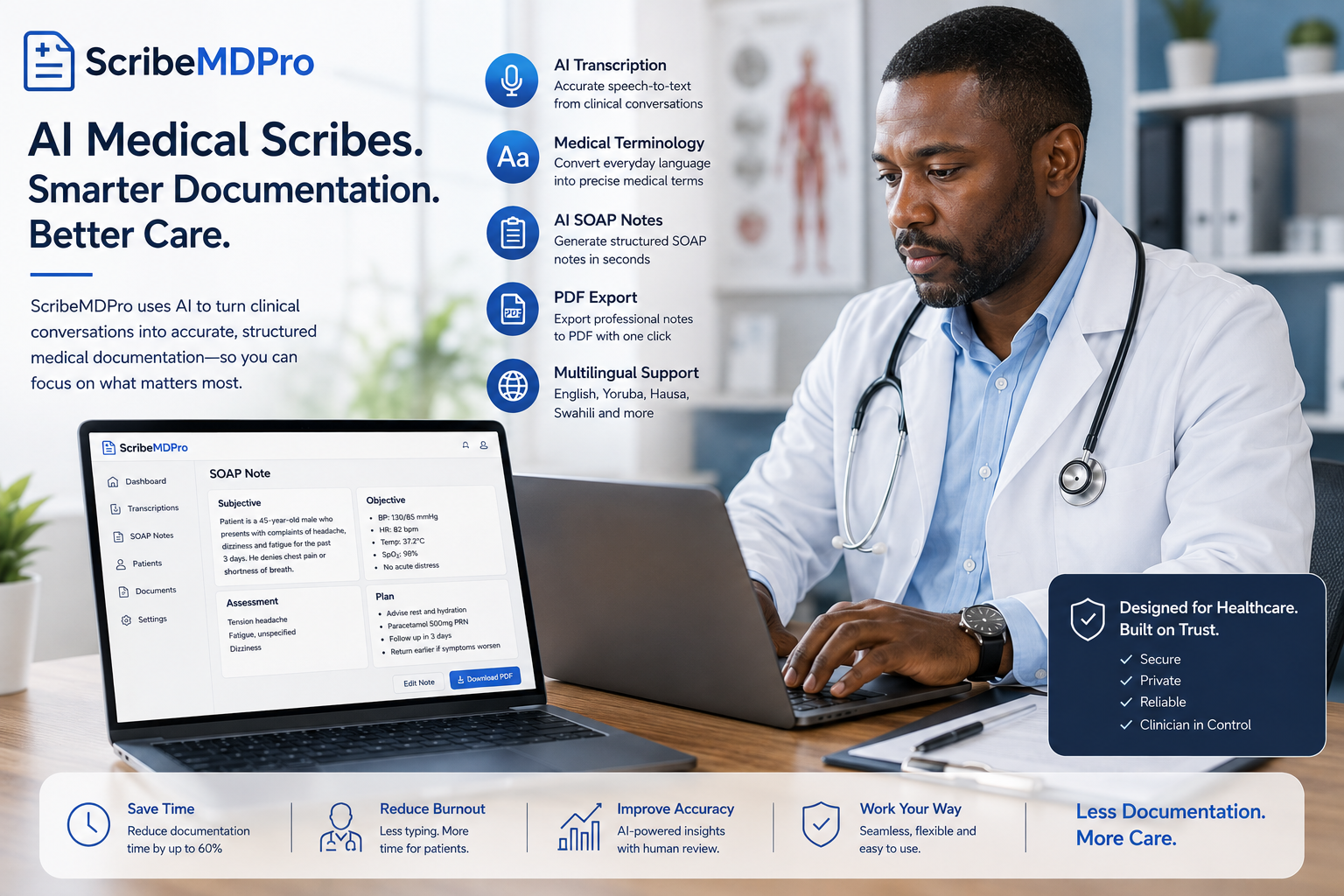
AI Medical Scribes: How ScribeMDPro Simplifies Clinical Documentation
Healthcare professionals spend a significant amount of time documenting patient encounters.
While accurate documentation is essential for continuity of care, communication, reporting, billing, and medical records, the process can also become one of the most time-consuming parts of clinical work.
Typing notes after every consultation, translating everyday descriptions into appropriate medical terminology, organizing information into a structured format, and preparing professional documentation can create a substantial administrative workload.
This is where AI medical scribe technology is becoming increasingly useful.
An AI medical scribe can assist healthcare professionals by converting clinical conversations into written documentation and helping organize information into a more structured format.
Instead of starting every note from a blank screen, clinicians can use AI-assisted documentation as a starting point and then review, correct, and finalize the content.
ScribeMDPro is designed around this idea: helping healthcare professionals spend less time dealing with repetitive documentation tasks and more time focusing on patient care.
What Is an AI Medical Scribe?
An AI medical scribe is a software system that uses artificial intelligence to assist with clinical documentation.
Traditional medical scribes may listen to a consultation and document important information for the healthcare professional.
AI medical scribes attempt to automate parts of this process using technologies such as speech recognition, natural-language processing, and generative AI.
A typical workflow may look like this:
Clinical conversation → AI transcription → Medical terminology processing → Structured clinical note → Clinician review → Final documentation
The important point is that AI documentation should assist the clinician rather than replace clinical judgment.
The healthcare professional remains responsible for reviewing the generated information, correcting inaccuracies, and ensuring that the final record accurately reflects the patient encounter.
This makes AI medical scribe technology particularly interesting for professionals who want to reduce repetitive administrative work without giving up control over their documentation.
Why Clinical Documentation Can Become a Burden
Clinical documentation serves an important purpose, but the process can be demanding.
A healthcare professional may need to document:
•Patient complaints •Symptoms •Medical history •Examination findings •Assessment •Treatment plans •Follow-up instructions •Diagnoses •Referrals •Other relevant clinical information
When documentation is completed manually, these tasks can require substantial typing and repetitive data entry.
The problem becomes even more noticeable when healthcare professionals see many patients in a day.
After several consultations, documentation can accumulate into a backlog. A clinician may then spend additional time completing notes after patient-facing work has finished.
This can contribute to administrative fatigue and reduce the amount of time available for other professional activities.
AI-assisted documentation offers a different approach: capture the relevant information first and use software to help transform it into a structured document.
How ScribeMDPro Helps
ScribeMDPro brings several documentation capabilities together in one platform.
The system is designed to help transform clinical conversations and information into professional medical documentation while allowing healthcare professionals to remain in control of the final record.
Here are some of its core capabilities.
- AI Transcription
One of the central features of ScribeMDPro is AI-powered transcription.
Instead of manually typing every part of a clinical conversation, users can record or provide the conversation to the system and allow AI to convert speech into text.
This can be particularly useful when a healthcare professional wants to capture information quickly before organizing it into a formal clinical note.
Transcription can also provide a foundation for additional documentation workflows.
Rather than beginning with an empty document, the healthcare professional starts with text that can be reviewed and transformed.
However, transcription should not be treated as automatically perfect. Accents, background noise, overlapping speech, medical terminology, and unclear audio can affect transcription quality.
That is why human review remains an important part of responsible clinical documentation.
- Medical Terminology Conversion
Patients and healthcare professionals do not always use the same language.
A patient might describe a symptom using everyday language, while a medical record may require a more standardized clinical term.
For example, a patient may say:
"I feel like my heart is racing."
An AI documentation system can help identify the clinical concept associated with that description.
ScribeMDPro is designed to help transform everyday language into more appropriate medical terminology.
This can make documentation more consistent and easier to interpret.
However, terminology conversion should be viewed as an assistive function, not an autonomous diagnostic process.
The healthcare professional should verify that the terminology accurately represents what the patient reported and what was clinically observed.
- AI SOAP Note Generation One of the most useful applications of AI in clinical documentation is structured SOAP note generation.
SOAP stands for:
S — Subjective O — Objective A — Assessment P — Plan
A SOAP note provides a structured way of documenting a clinical encounter.
ScribeMDPro can help organize relevant information into a SOAP-style format, reducing the amount of manual formatting required from the healthcare professional.
For example, information from a consultation can be transformed into sections covering the patient's reported symptoms, relevant findings, clinical assessment, and proposed plan.
The advantage is not simply that the text is generated faster.
The larger benefit is organization.
When information is already structured, clinicians can review it more efficiently and identify areas that require correction or additional information.
Again, AI-generated documentation should always be reviewed before it becomes part of a patient's official record.
- Professional PDF Export
Documentation often needs to be shared, stored, printed, or incorporated into other workflows.
ScribeMDPro includes PDF export capabilities that allow users to generate professional documents from their completed notes.
This can be useful for workflows involving:
•Clinical documentation •Referral materials •Professional records •Administrative documentation •Documentation archives •Other approved healthcare workflows
A structured PDF can also provide a cleaner presentation than copying unformatted text from one application to another.
The goal is to make the transition from AI-assisted documentation to a usable professional document as straightforward as possible.
- Multilingual Support
Healthcare is increasingly multilingual.
Clinicians may work with patients who speak different languages, particularly in multicultural communities and international healthcare environments.
ScribeMDPro supports multiple languages, including English, Yoruba, Hausa, and Swahili, with additional language capabilities being developed and expanded.
Multilingual support can help make AI-assisted documentation more accessible to healthcare professionals working across different linguistic environments.
For example, a clinician working in an environment where patients communicate in Yoruba may have different documentation needs from a clinician working primarily in an English-speaking environment.
Language support therefore isn't simply a convenience feature. It can be an important part of making healthcare technology more inclusive.
Nevertheless, users should carefully review AI-generated content when language differences, translation, dialects, or specialized medical terminology could affect meaning.
AI Medical Scribes and Clinician Productivity
The strongest argument for AI medical scribes is not that they eliminate documentation.
It is that they can potentially reduce repetitive documentation work.
Consider a typical workflow. Traditional workflow A clinician:
1.Conducts the consultation. 2.Takes notes manually. 3.Reorganizes the information. 4.Types the clinical documentation. 5.Structures the note. 6.Reviews the document. 7.Finalizes the record.
AI-assisted workflow
AI-assisted workflow A clinician can instead:
1.Conduct the consultation. 2.Capture the relevant conversation. 3.Allow AI to transcribe the information. 4.Generate a structured draft. 5.Review and correct the draft. 6.Finalize the documentation.
The clinician still participates in the process, but the repetitive formatting and drafting work can be reduced.
That distinction is important.
AI should support clinical professionals, not replace them.
Why Human Review Still Matters
AI medical documentation has enormous potential, but healthcare requires a higher standard of accuracy than many ordinary applications.
A transcription error can change the meaning of a sentence. A terminology error can introduce ambiguity.
An AI-generated statement can potentially sound medically plausible while still being incorrect.
For these reasons, clinicians should review AI-generated documentation before finalizing it.
A responsible workflow should include:
AI generation → Human verification → Correction → Final approval
Healthcare professionals should verify important details such as medications, dosages, symptoms, diagnoses, examination findings, allergies, dates, and treatment plans.
ScribeMDPro is intended to assist with documentation—not to assume responsibility for clinical decision-making.
Choosing the Right AI Medical Scribe
There are many factors healthcare organizations and individual professionals should consider when evaluating an AI medical scribe.
- Documentation workflow
Does the platform actually fit the way you document patient encounters?
A tool should reduce friction rather than introduce additional complicated steps.
- Accuracy
Transcription and generated documentation should be reviewed for accuracy.
Look beyond marketing claims and evaluate how the tool performs with real-world speech, terminology, accents, and clinical conversations.
- Structured documentation
A useful AI medical scribe should help organize information rather than simply produce a block of text.
SOAP notes and other structured formats can make documentation easier to review.
- Language support
For multilingual environments, language availability can be an important consideration.
- Export options
Consider whether you can easily export or use the documentation produced by the platform.
- Privacy and security
Healthcare organizations should carefully evaluate how patient information is collected, processed, stored, transmitted, and protected.
Do not assume that an AI product is automatically suitable for regulated healthcare information simply because it uses AI.
Organizations should review the provider's privacy, security, contractual, and compliance documentation and determine whether the product meets their specific legal and regulatory requirements.
The Future of AI-Powered Clinical Documentation
AI medical scribes are part of a broader transformation occurring across healthcare technology.
Future documentation systems are likely to move beyond transcription and basic note generation.
Potential capabilities include:
•Clinical coding assistance •Clinical summaries •Medication extraction •Laboratory result organization •Referral letter generation •Discharge summary generation •Medical letter generation •Voice-controlled workflows •Clinical analytics •Team collaboration •Integration with electronic medical record systems
The objective is not to create technology that makes clinical professionals unnecessary.
Instead, the goal is to create systems that remove repetitive administrative tasks and allow healthcare professionals to devote more attention to patients.
ScribeMDPro: Built for the Documentation Problem
ScribeMDPro was created around a simple problem: clinical professionals should not have to spend unnecessary amounts of time turning conversations into documentation.
Its AI-powered workflow combines transcription, medical terminology conversion, SOAP note generation, PDF export, and multilingual capabilities in one platform.
For healthcare professionals exploring AI medical scribes, the value proposition is straightforward:
Capture → Transform → Structure → Review → Document.
The technology handles repetitive parts of the workflow while the healthcare professional maintains control over the final documentation.
As AI continues to develop, responsible implementation will become increasingly important.
Accuracy, privacy, security, clinician oversight, and transparent workflows should remain central to healthcare AI adoption.
The future of clinical documentation is not necessarily about replacing the human professional.
It is about giving that professional better tools.
And that is where ScribeMDPro aims to make a difference.
Final Thoughts
Clinical documentation will always be an essential part of healthcare.
But essential does not have to mean unnecessarily burdensome. AI medical scribes can help healthcare professionals reduce repetitive typing, organize information, generate structured notes, and create professional documentation more efficiently.
ScribeMDPro brings these capabilities together while keeping the healthcare professional at the center of the workflow.
As healthcare continues to adopt artificial intelligence, the most valuable systems will be those that combine automation with human oversight.
The objective is simple:
Less time spent fighting documentation. More time available for meaningful healthcare.
Ready to simplify clinical documentation?
Explore ScribeMDPro and discover how AI-powered transcription, medical terminology conversion, SOAP note generation, PDF export, and multilingual support can fit into your documentation workflow.
Visit ScribeMDPro @scribemd.site