AI Documentation vs Human Medical Scribes: Which Is Better for Modern Healthcare?
Discover the key differences between AI medical scribes and human scribes, and learn how AI is reshaping clinical documentation without replacing clinicians.
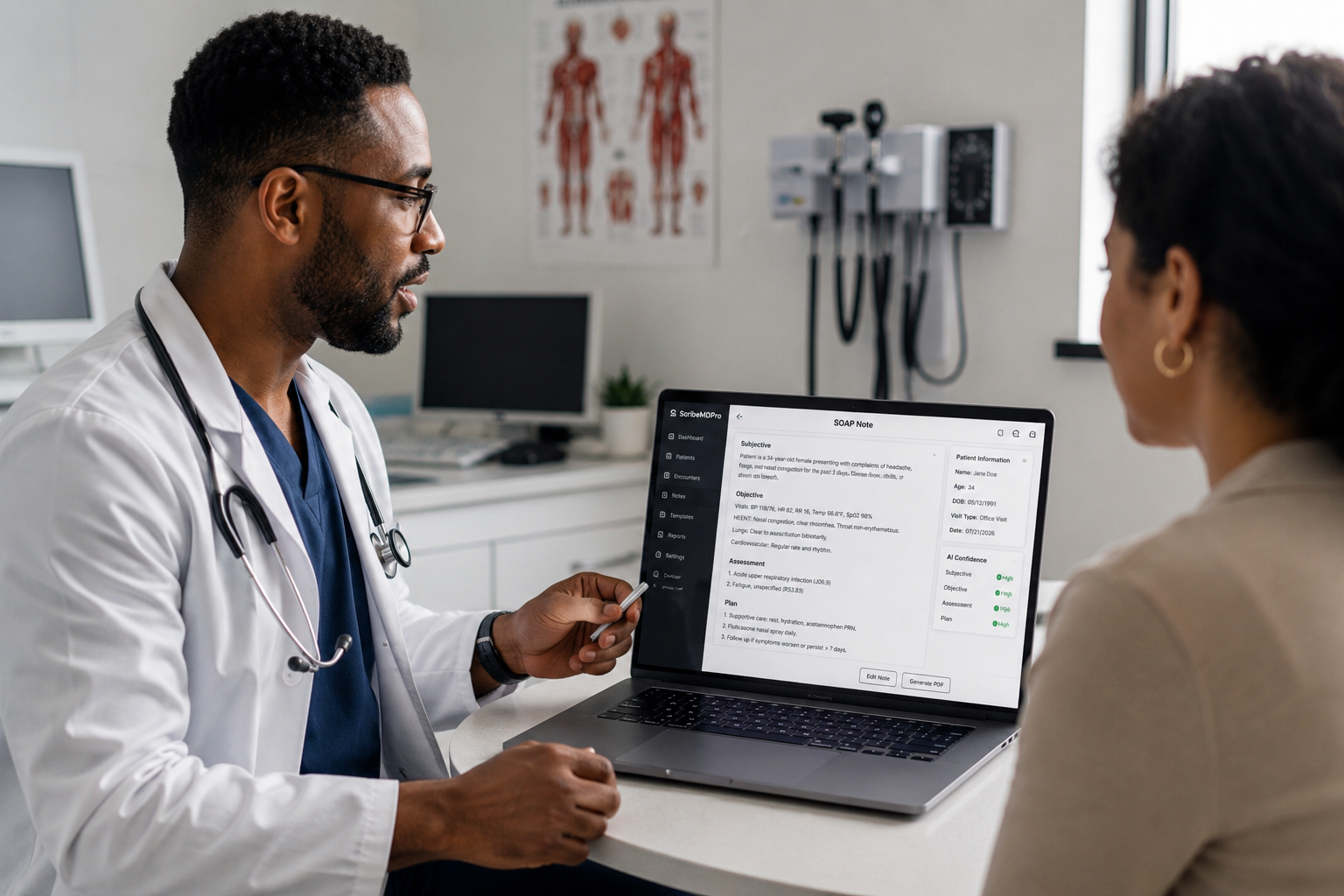
AI Documentation vs Human Medical Scribes: Which Is Better for Modern Healthcare?
Healthcare documentation has evolved significantly over the last decade. As physician burnout continues to rise and documentation requirements become increasingly complex, many healthcare organizations are evaluating whether AI medical scribes can replace or complement traditional human scribes.
The answer isn't as simple as choosing one over the other. Each approach offers distinct advantages depending on clinical workflows, specialty, budget, and documentation needs.
This article explores the differences between AI documentation and human medical scribes to help healthcare professionals make informed decisions.
What Is a Human Medical Scribe?
A human medical scribe is a trained individual who accompanies a physician—either in person or virtually—and documents patient encounters in real time.
Responsibilities often include:
•Recording patient history •Documenting physical examinations •Preparing SOAP notes •Updating electronic health records (EHRs) •Assisting with clinical documentation
Human scribes have supported healthcare providers for many years, especially in busy emergency departments and outpatient clinics.
What Is an AI Medical Scribe?
AI medical scribes use speech recognition, natural language processing (NLP), and clinical AI models to automatically convert clinician-patient conversations into structured clinical documentation.
Modern AI scribes can:
•Transcribe conversations •Generate specialty-aware SOAP notes •Produce clinical summaries •Suggest ICD coding support •Reduce administrative workload •Deliver documentation within seconds.
Unlike human scribes, AI systems operate continuously without scheduling constraints.
Comparing AI Documentation and Human Scribes
Speed
Human Scribe
•Requires manual typing •Documentation speed depends on the individual
AI Medical Scribe
•Generates notes within seconds •Immediate documentation after consultation
Winner: AI
Cost
Human scribes require:
•Salaries •Training •Benefits •Scheduling •Ongoing supervision
AI documentation platforms typically operate through predictable subscription models that can be more cost-effective, particularly for larger practices.
Winner: AI
Availability
Human scribes are limited by work schedules, vacations, and staffing shortages.
AI operates 24/7 and scales without additional personnel.
Winner: AI
Clinical Judgment
Experienced human scribes may recognize contextual nuances that current AI systems may not always capture.
AI should support—not replace—clinical decision-making.
Winner: Human
Consistency
AI produces standardized documentation with consistent formatting, while human documentation may vary by individual.
Winner: AI
Scalability
A healthcare organization may need dozens of human scribes to support multiple providers. An AI platform can support thousands of clinicians simultaneously.
Winner: AI
Where Human Scribes Still Add Value
Human scribes remain valuable in situations involving:
•Highly complex patient encounters •Clinical training environments •Workflows requiring extensive manual coordination •Settings where AI adoption is still limited
Many organizations also use hybrid models combining AI with human quality review.
The Future Is Collaborative
The future of clinical documentation is unlikely to be AI versus humans.
Instead, healthcare systems are increasingly adopting AI to automate repetitive documentation while clinicians retain full authority over reviewing, editing, and approving notes before they become part of the medical record.
This collaborative approach can improve efficiency without compromising patient safety.
How ScribeMDPro Supports Clinicians
ScribeMDPro is designed to reduce documentation burden while keeping clinicians in control.
Key capabilities include:
•Ambient AI transcription •Specialty-aware SOAP note generation •Clinical summaries •Secure, HIPAA-aware workflows Fast, structured documentation •Clinician review before finalization
Rather than replacing healthcare professionals, ScribeMDPro helps them spend less time typing and more time caring for patients.
Final Thoughts The question is no longer whether AI will become part of healthcare documentation—it already has.
The more important question is how healthcare organizations can implement AI responsibly to improve efficiency, reduce burnout, and maintain high standards of clinical documentation.
The future belongs to solutions that combine the speed of AI with the expertise and judgment of clinicians.